I Kept a “To Donate” Box for Months. It Never Once Left My Closet.
There’s a box in my closet marked “donate” in Sharpie, almost a year now. I know exactly what’s in it. I’ve moved it twice — once to vacuum under it, once because it was in the way of the vacuum itself. Both times I thought about actually taking it somewhere. Both times I put it back.
I used to think that box meant I was almost done. Turns out it just meant I’d found a more respectable place to keep my clutter than the floor. If you’ve ever felt it too, that’s the version of decluttering guilt I want to talk about — not the kind about losing things you love, but the kind that shows up when you finally get rid of something and somehow still feel like you did it wrong.
The part I didn’t expect
Here’s what actually happens to a “donate” box, at least in my house. It sits. Then it becomes furniture. Then, eventually, on a day I’m not even trying to declutter — I’m just annoyed it’s still there — I picked it up on my way to take out the trash, and it went straight in the bin. No ceremony.
The second it hit the trash can, I felt something I wasn’t expecting: not relief exactly. Guilt. Like I’d cheated. Like there was a right way to get rid of things — careful sorting, the correct hands to hand it to, a small act of usefulness at the end — and I’d skipped it and taken the lazy way out.
That’s the part worth sitting with, because it’s backwards. The box sat untouched for almost a year. Nothing about it was helping anyone in that time. It wasn’t donated. It wasn’t used. It was just occupying a shelf, and occupying a small corner of my attention every time I saw it. The trash can didn’t make it less useful than it already was. It just ended the pretending.
What I think the guilt is actually about
I went looking at how other people talk about this — mostly on decluttering forums — expecting to find people who couldn’t let go of things. That’s not really what’s there. What’s there is people who already decided to let go, and are stuck on the method. Post after post of “I know I should donate this but I just don’t have it in me to sort it, find the right place, drive it somewhere” — followed by other people telling them, essentially, it’s fine, just throw it away.
That reassurance wouldn’t need to exist as its own genre of comment if the guilt were really about the object. Nobody needs permission to feel less attached to a stack of old cords. They need permission to skip a chore they’ve quietly turned into a moral test.
The trap inside “doing it properly”
Here’s the part I didn’t expect to find in myself until I looked closely: sometimes the thing that stops me from giving something away isn’t laziness. It’s my own definition of what “giving properly” is supposed to look like.
Before I let a bag of things leave my house, I used to run it through a whole silent checklist. Which group actually needs this? Are they legitimate, or is this one of those pages that resells donations for profit? Where are they located, do they even take drop-offs, do I need an appointment? By the time I’d half-answered those questions, I hadn’t given anything away — I’d just spent an hour building a case for why I hadn’t done it yet.
I’d made “properly” so specific that almost nothing could clear the bar. Which meant the bag didn’t move. The good intention was real. It just never turned into an actual afternoon.
The honest complication
I’m not going to pretend donating is pointless, because it isn’t, and I still do it — when it’s simple enough to actually happen. The clothes my kids outgrew, along with toys they’d stopped touching, went to the woman who cleans our building. I asked her, in passing, if she could use any of it. She said yes. That was the whole process — a few minutes of conversation, no research, no forms, no bag labeled and left on a doorstep hoping it reached the right hands. It reached someone who needed it because I asked a real person a real question, instead of trying to verify a stranger’s charity online first.
That’s the contrast that convinced me. The donation that actually happened took less effort than the one I spent a year not doing. The problem was never donating. The problem was treating “the perfectly vetted, perfectly proper donation” as the only acceptable outcome — which quietly ruled out every faster, messier, still-completely-legitimate way of giving something to someone who could use it.
So here’s the line I use now, and it’s not clever, it’s just honest: if it’s been sitting in a bag or a box for more than a month, it goes in the trash — no more waiting for the perfect donation window. If I can get it into someone’s actual hands today, even if that’s not the tidiest version of giving, I do that instead. What I don’t do anymore is let “I should really find the right place for this” become the reason a bag of things I’ve already decided to release sits untouched for months, quietly taxing my attention every time I walk past it.
The Desk Test
A box only works if something makes you open it again.
The version I use for a desk puts a date on the box for me, and emails me on day 14 to ask what I actually went back for.
Where I landed
The box is gone now. Not donated — I’ll say that plainly, because pretending otherwise is the exact thing I just spent this whole post arguing against. It went in the trash on an ordinary day, for no more dramatic a reason than I was tired of looking at it. What I do differently now is put a date on the box before it goes anywhere — a box only does its job if something makes you open it again, which is precisely what this one never had.
What I actually changed wasn’t how I get rid of things. It’s that I stopped needing the ending to look responsible in order to let it happen at all.
If you’ve got a box like mine sitting somewhere right now — I’d like to know how long it’s actually been there. Not the number you’d tell a friend. The real one. There is a version of this box that works, and the only difference is that it is a box you are allowed to go back into.
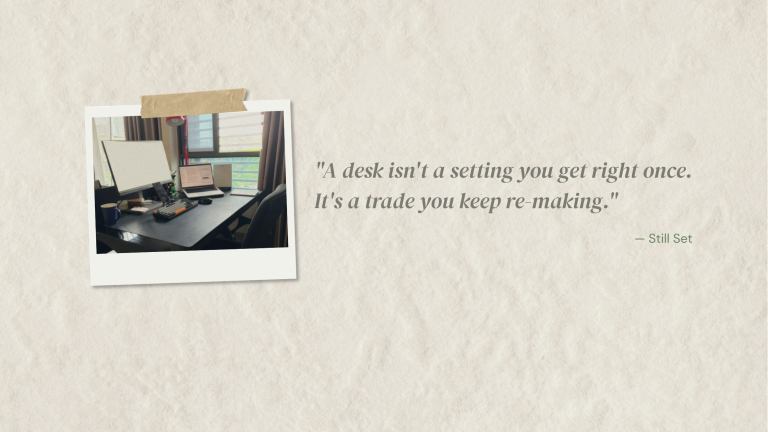
— Still Set
Try it on your own desk
What’s actually earning space on your desk?
Two minutes, one question, whatever is in front of you right now. You’ll end up with three lists — keep, go, and the one you couldn’t call either way.
No account, nothing saved, nothing to install.
Some posts on Still Set may contain affiliate links. This isn’t one of them — there’s nothing to sell around throwing a box away.