How to Decide What to Get Rid Of: I Put Four Things in a Box and Waited Two Weeks
On 14 August I took four things off my desk, put them in a box, and carried the box to the other side of the flat. Two rules. I was not allowed to throw anything away for fourteen days. And I was not allowed to pretend I didn’t know where the box was, so if I wanted something I had to walk over and get it, and write down that I had.
I did this because I had run out of honest ways to answer the only question that matters when a desk gets crowded. Every guide on how to decide what to get rid of hands you a rule, and every rule breaks on the same sentence: what if I need it later. That sentence cannot be argued with. It can only be checked.
What was in the box, and what each thing was for
Each of the four had a real job, and I could describe the job out loud, which is exactly why none of them had ever been thrown out.
The charger was the kind that plugs straight into a wall socket or into the laptop, so it lived plugged into the laptop and charged my phone at the same time. The headphones sat there waiting for the evenings when I need to listen to something with the children in the room and would rather not fill the room with it. The tissues were there so that anything spilled could be wiped the second it happened, which felt like the way a desk stays clean permanently rather than in bursts. The notebook I bought myself, for the notes that don’t feel heavy enough when they’re typed. Writing something by hand is what makes me feel I’ve actually taken hold of it.
Four objects, four reasons, all of them true. On the day I packed the box I wrote no prediction down. I only had a feeling, and the feeling was about one item: maybe I still need this charger here.
Days 2 to 13: what a diary looks like when nothing happens
There are no entries for these days, and that is the finding rather than a gap in the record.
With one exception. I went and fetched the charger, and then I fetched it again, and I kept fetching it every time the phone got low. Not because it was the only charger in the flat. There are others. It was because the phone has to sit within reach of the desk so I can pick it up the moment something needs doing on it, and a single cable running from the laptop is the shortest way to make that true. On 14 August I had assumed I would simply accept charging the phone somewhere further away. I did not accept it for a single day.
So the charger was never really in the box for two weeks. It was in the box between charges.
Nothing else moved. No entry, no fetch, no note. Twelve days of a completely empty page for three of the four items.
Day 14: I could not remember what was in the box
On 28 August I opened it, and before I could sort anything I had to go and check what I had written down on the 14th, because I could not name all four from memory.
I knew about the charger, obviously, since I had been visiting it. I knew the headphones were in there. The other two I could not call with any confidence. Two of the four objects that had earned permanent space on my desk had left my head entirely inside a fortnight, and I only got them back by reading my own handwriting.
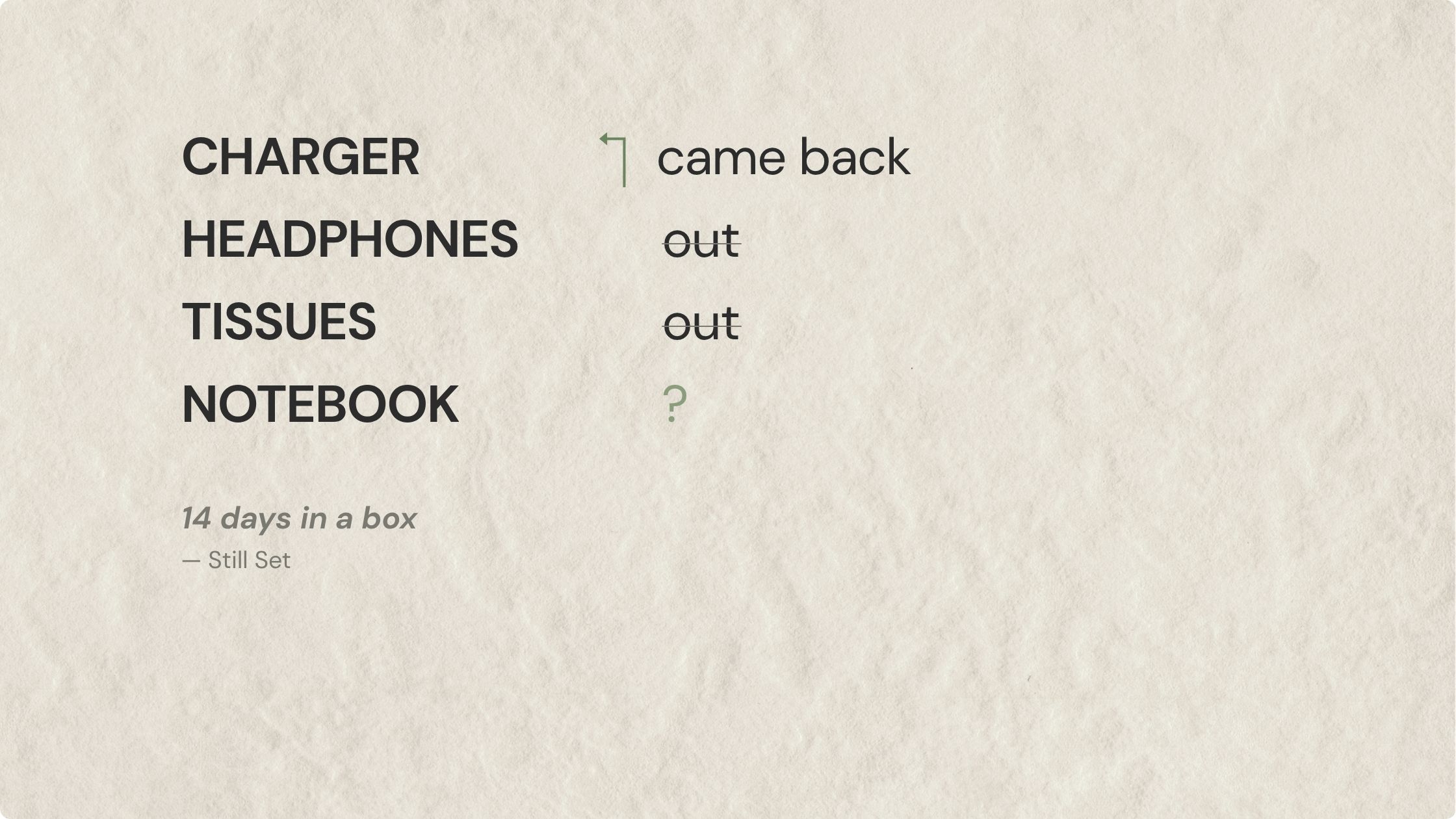
The sorting after that took about a minute. The charger went back on the desk. The headphones and the tissues did not. The notebook I could not decide about, so I left it where it was.
Why did two of the four fail the test?
The two that failed were not useless, and that turned out to be the whole point.
The charger was serving something that already happens. The phone runs low every day, without variation, whether or not I’m thinking about it. It earns its place by arithmetic.
The headphones and the tissues were serving a scene. I could picture the scene precisely: the children in the room and me needing to hear something without it filling the space; a coffee ring appearing and a hand reaching for a tissue before it dries. Both scenes are real. Both have happened. They simply happen far less often than they are easy to imagine, and a thing that earns its place by imagination has no way to keep count of itself.
That is the split the box actually measured. Not useful against useless. Routine against scene.
I had spent months before this treating the problem as a sorting problem, and what I kept finding instead was that a cluttered desk is what indecision looks like when it is left out on a surface. The box didn’t help me sort. It settled two arguments I had been unable to settle on my own.
The Desk Test
Routine or scene. That is the whole sort.
This asks the same question about each thing on your desk and hands back three lists, including one for the things you couldn’t call either way.
Why is “what if I need it later” impossible to answer at the desk?
Because when the object is on the desk, the question you are actually being asked is whether you will give it up, and that is a loss.
Move the same object into a box and the question quietly changes. Now it asks whether you will go and get it, and that is a gain. Same object, same fortnight, two different questions, and people answer those two questions very differently. Kahneman, Knetsch and Thaler published a set of experiments in the Journal of Political Economy in 1990 showing that the median price people demanded to give up an object they had just been handed was more than twice what people without one were willing to pay for the same object. Ownership alone moved the number.
This is why the sentence is unanswerable at the desk. Sitting there, the thing is already yours, and every calculation is running from the wrong reference point. The box does not argue with you about it. It just moves the object out of the “already mine” column for fourteen days and lets your feet report back.
The Desk Test is that question, applied to every object on a desk. It is the only question Still Set has for a desk: would I go and get this if it weren’t here. The charger answered on day one. The headphones and the tissues answered by never coming up.
Day 26: the notebook is still in the box
It is 9 September, and the notebook has not come back and has not left.
It fits neither category. It isn’t a routine, because I don’t write in it daily. It isn’t quite a scene either. What it does is this: some notes don’t register when I type them, and writing the same thing by hand makes me look at the detail more calmly than looking at a note app open on a screen. Those moments are getting rarer. That may be the format losing an argument, or it may be that I am simply getting lazier about it, and I can’t tell which from the inside.
The box settled the charger in a day. It settled the headphones and the tissues in fourteen. It cannot settle this one, and I’ve stopped expecting it to, because what the notebook does isn’t a job. It is a feeling, and the test has no instrument for feelings.
Which is the honest shape of the whole thing. You keep some objects for the work they do, and a fortnight in a box will tell you the truth about those. You keep others for the state they put you in, and those will sit in the box until you decide something the box was never going to decide for you.
The notebook is no longer in the box. It is back on the desk, and I kept it against my own evidence.
What are the limits of this test?
The test only measures how often you reach for something, so it is wrong about anything whose value is not frequency.
Four objects, one desk, one person, one fortnight. That is an anecdote with a date on it, not a study.
Fourteen days is a number I picked, not a number I derived. Anything seasonal fails it unfairly. A raincoat boxed in August is not being tested, it is being ambushed.
The test punishes rarity, and some rare things deserve to stay precisely because nothing substitutes for them on the day they are needed. A spare key does not need to justify itself weekly.
It rules on nothing sentimental, and it shouldn’t be asked to. Still Set has no method for the objects you keep because of who gave them to you, and I would be suspicious of one that claimed to.
And it only works if retrieval is genuinely easy. If the box goes in the loft, you haven’t built a test, you’ve built storage. I have kept a box marked donate that never left the house, and the difference between that box and this one is entirely about whether going back is allowed.
What I’d tell someone starting this
Start with four things, not forty, and pick the ones you would defend if someone asked why they were there.
Put the box somewhere you would actually walk to. Same floor, no lid you have to fight.
Write the date and the four items down on day one. You think you will remember. I had four objects and twelve days, and I did not.
Write one line per item about what you expect to use it for. Not a yes or no guess, just the use you have in mind. I skipped this and it cost me the sharpest comparison in the whole exercise, because I have no record of what I predicted, only a vague memory of a feeling about a charger.
Count trips, not opinions. A trip is data. An opinion at day nine about how you would probably feel at day fourteen is not.
On day fourteen, anything you had to fetch goes back. Anything you had forgotten was in there goes out. Anything you cannot call either way stays in the box, and you say so out loud instead of quietly resolving it in favour of keeping.
— Still Set
Your own fourteen days
The box only works on the things you can’t decide about.
Three lists, two minutes, and a box for whatever you couldn’t call. We email you once on day fourteen to ask what you went back for.
No account, nothing saved, nothing to install.
Read more: Home & Space