I Tried to Clear My Desk. The Problem Wasn’t the Clutter.
For about a year, my desk had a routine that went like this.
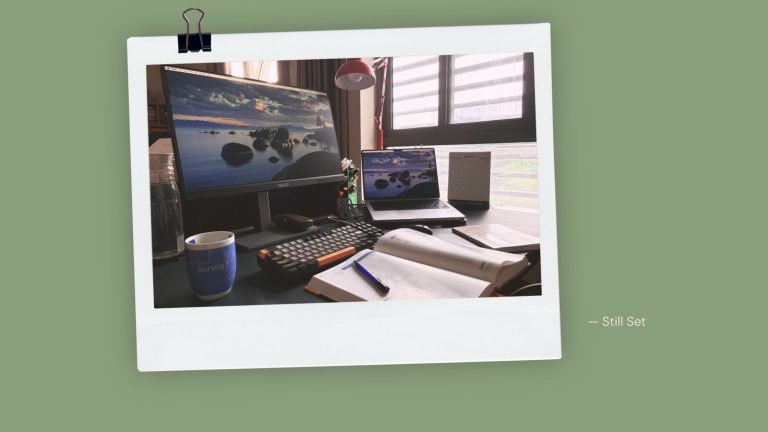
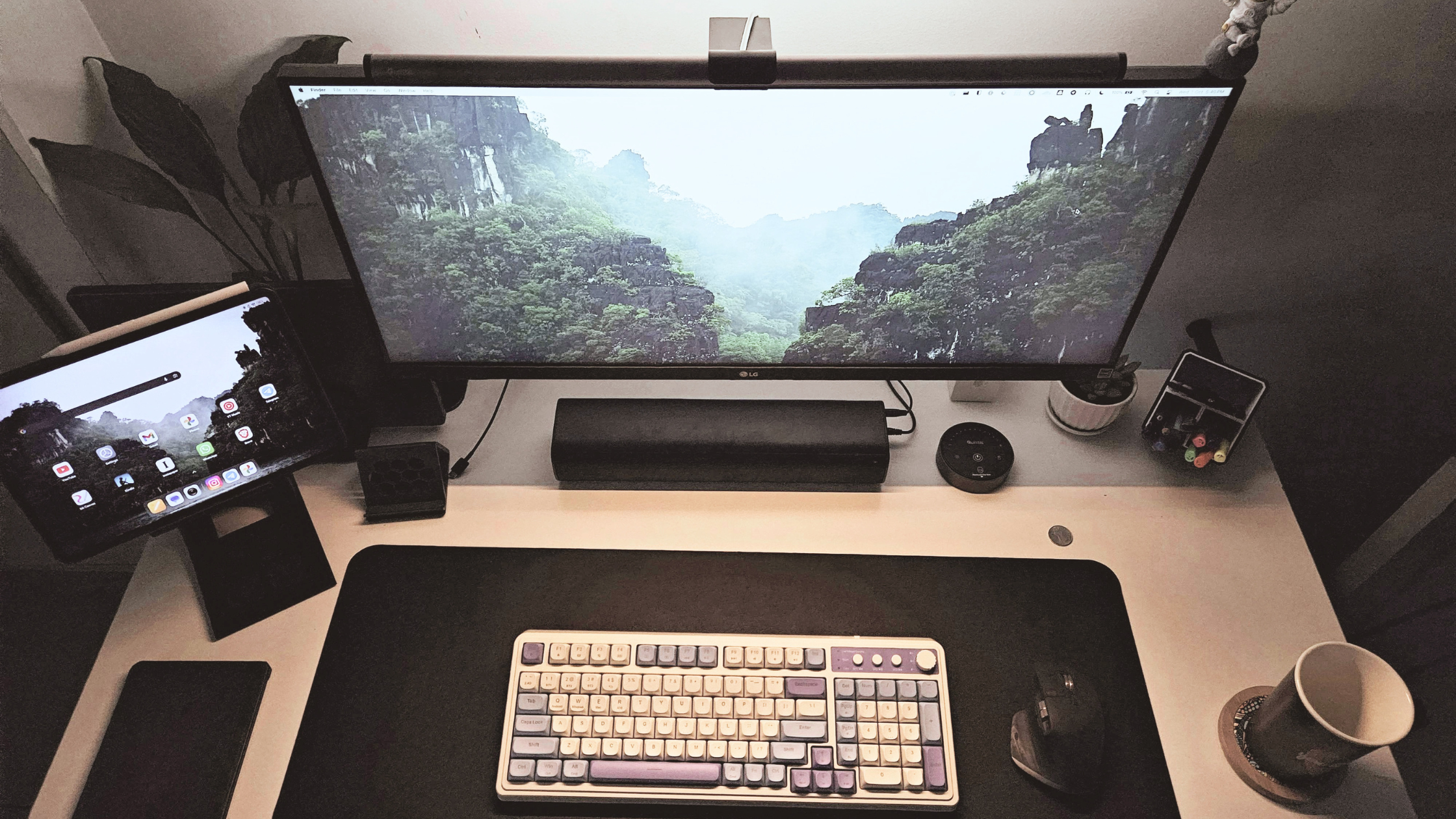
I’d look at it on a Monday morning — the second monitor I’d added so I could actually see things, a lamp, a glass of water gone slightly warm, a pen holder with little compartments for sorting pens by type that I no longer sorted, a notebook, and then a slow drift of other stuff: a charger I wasn’t using, a receipt, a second notebook I’d started and abandoned. And I’d think, right, I’ll clear this.
Then I’d pick something up — say, the charger — and a small voice would go: but what if I need it later? So I’d put it down again. Maybe move it two inches to the left. Tell myself I’d leave it there for a few days and see if I reached for it.
There was never a few days later. There was just the desk, the same as before, except now I’d spent ten minutes lifting things up and setting them back down without deciding anything.
I read a lot of advice about clearing a desk while I was in this state. Almost all of it says the same thing: take everything off, sort it into keep, store, toss, put back only what you use every day. It’s good advice. It’s also completely useless if you’re me, because the sorting was never my problem. I knew which things I didn’t use. I just couldn’t make myself let them go.
The thing nobody tells you about a cluttered desk is that it’s often not a tidying problem. It’s a deciding problem. The clutter is just what indecision looks like when it piles up.
This is the same trap I wrote about when I stopped trying to be productive — the harder I pushed at the surface problem, the more I missed that the real one was underneath. Same shape here. The mess on the desk wasn’t the thing. The thing was that I wouldn’t decide.
What actually moved it
What broke the loop wasn’t a system or a box of organizers. It was changing the question.
Instead of “do I use this every day?” — which let me argue with myself forever — I asked: “if this weren’t here right now, would I go and get it?”
That’s a different question. It’s not about whether something is theoretically useful. Almost everything is theoretically useful. It’s about whether, in the actual moment, I’d stand up and walk to a drawer for it. Most things, the answer was no. The charger, no. The abandoned second notebook, no. The receipt, obviously no.
The Desk Test
That’s the whole test. I built it into a two-minute version.
You name what’s on your desk, it asks you the same question about each one, and you end up with three lists instead of a pile.
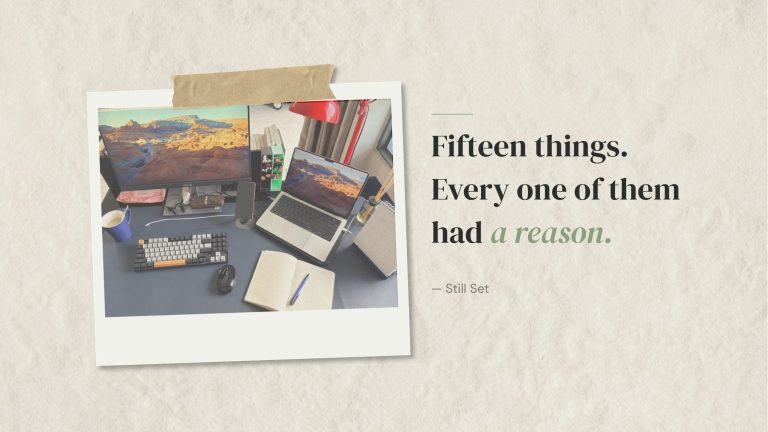
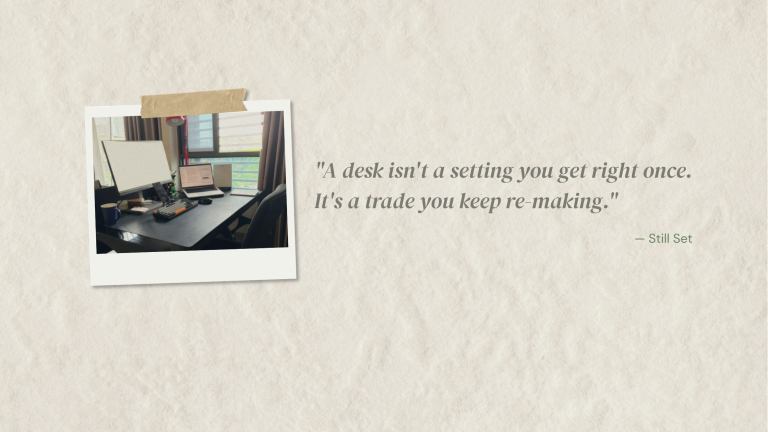
So I cleared it down. What stayed was small: my screen setup, a lamp, a glass of water, the pen holder, and one notebook.
Five things, not three — I’m not going to lie to you and round it down to a nicer number for the headline. The screens and the lamp and the water aren’t interesting; they’re just the work and the conditions to do it. The two that mattered, the two I actually had to think about, were the pen holder and the notebook.
The one I put away, then went and got back
Here’s the part that surprised me, and the part the desk-clearing articles don’t prepare you for: sometimes the thing you’re scared to lose is one you actually need.
I’d decided the notebook and pen were clutter. They felt like the kind of analog thing you keep around to feel organized. So I put them in a drawer across the room — passed my own test, in theory, because a drawer is “store, not toss.”
Within two days I’d brought them back.
It turns out that when I think on a screen — typing a task, making a note in an app — the thought doesn’t fully land. Something about writing it by hand pulls the whole thing out of my head in a way typing doesn’t. I lean on screens for most of my actual work — the small, boring stack of tools I genuinely use — but the thinking, the figuring-out-what-I-mean part, still happens on paper. And the drawer across the room wasn’t a neutral place to keep them. Every time I needed to scribble something, standing up to walk over there became its own small distraction — exactly the kind of friction that breaks focus.
So the notebook came back to the desk, and the pen holder with it. Not because I was scared to lose them. Because I tested losing them and found out they earned the space.
That’s the difference I missed for a year. “What if I need it later” is a fear. “I tried being without it and I reached for it constantly” is information. One keeps the desk frozen. The other lets you decide.
What this cost
Nothing. That’s the honest part. I didn’t buy a single thing to do this. The lamp is one I already had — a basic, no-name desk lamp that’s fine. The pen holder is one I’ve had for years. The notebook is just a notebook.
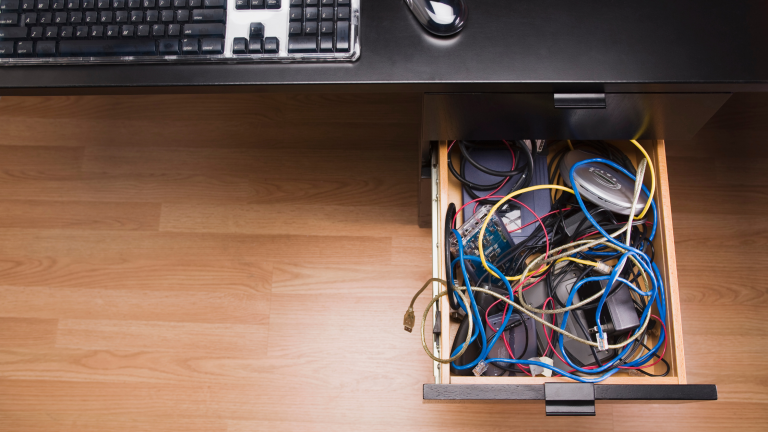
If you want me to point you at gear, I can’t really, in good conscience, for this one. The whole point is that the change was a decision, not a purchase. The one thing I’d say is worth its space, if your desk has the same slow cable drift mine did, is something to corral the cords — a simple cable management tray under the desk made the “miscellaneous chargers” pile stop reforming, because the cables that belonged there had a home and the ones that didn’t became obvious. That’s the only thing I’d actually spend money on here, and it’s the kind of thing that costs less than a lunch. (I haven’t tried every version of these — the principle matters more than the brand.)
The part that stuck
It’s been a few months. The desk hasn’t drifted back, and I think it’s because I didn’t change the desk — I changed the question I ask when something lands on it. “Would I go get this if it weren’t here?” is fast. It doesn’t let me negotiate. It doesn’t work on everything, though. For a drawer of eleven near-identical chargers, setting a number first is the better instrument — the question only earns its keep when every object is one of a kind. And when the answer is yes — like the notebook — I get to keep the thing without guilt, because I know it earned its place instead of just sitting there out of habit.
I’m no minimalist. I’m not going to tell you to get down to three items, partly because I didn’t. This is the first of a few pieces I’m writing about the space I actually work in — you can find the rest here, as I add them. The desk itself has moved three times since then, and it turned out where I put it mattered nearly as much as what I left on it — but that’s a separate piece. I just stopped letting “what if I need it later” make my decisions for me, and the desk got quiet.
There’s a version of this where the tidying itself was the thing I was avoiding, which took me another six months to notice.
If you’ve got a desk that you keep meaning to clear and somehow never do — I’d genuinely like to know what’s on it that you can’t seem to put away. That’s usually the interesting part. Tell me in the comments. I later wrote about where the desk sits in the room and how I keep it from drifting back — here.
Want to know what’s actually earning its space on your desk? Take the desk test → Ten minutes, one question.
— Still Set
Try it on your own desk
What’s actually earning space on your desk?
Two minutes, one question, whatever is in front of you right now. You’ll end up with three lists — keep, go, and the one you couldn’t call either way.
No account, nothing saved, nothing to install.
Some of the links on Still Set may be affiliate links. If you buy through one, I might earn a small commission — at no extra cost to you. I only ever point to things I’d actually use myself, and when I haven’t tested something, I’ll say so plainly.