Deciding What to Keep First Works. Just Not on a Desk.
Almost every decluttering method in circulation begins the same way: decide what you want to keep, rather than what you want to get rid of. Marie Kondo built a career on a version of it. Joshua Becker puts it as plainly as it can be put — stop asking what you can remove, ask what you need to keep.
I think that advice about what to keep when decluttering is correct for roughly a third of the objects in a house, and I think it is close to useless for the rest. The interesting part isn’t which camp you belong to. It’s that you can tell, in about five seconds, which method a given pile needs.
The case for deciding first is stronger than most people who repeat it realise
Deciding in advance is cheaper than deciding a hundred times, and that is not a small advantage — it’s the whole reason the method exists.
Jennifer at Simply + Fiercely describes working out ahead of time what her wardrobe would and wouldn’t contain — the silhouettes, the colours, the things she’d stopped reaching for. The point wasn’t discipline. It was that a boundary set once removes the emotion from every individual decision after it. You aren’t negotiating with a jumper. You’re checking it against something you already settled while calm.
That matters more than it sounds if the only window you have for this is after work, after dinner, after everyone else is finally asleep and you have maybe forty minutes and no reserves. Decision fatigue isn’t a metaphor at that hour. A method that spends your judgement one object at a time is a method that will run out before the room does.
And here is the failure mode of my preferred approach, stated as strongly as I can state it, because I’d rather be the one to say it: object-by-object questioning lets every item pass locally while the room fails globally. Ask “would I go and get this” about one charger and the answer is plausibly yes. Ask it about the fourth charger and the answer is still plausibly yes — because in that moment you’re not comparing it to the other three. You’re comparing it to nothing. You can question your way through a hundred objects, honestly, in good faith, and keep ninety.
That isn’t hypothetical. When UCLA’s Center on Everyday Lives of Families spent four years inside 32 dual-income Los Angeles households — published in 2012 as Life at Home in the Twenty-First Century — one finding was how many of those garages had filled so completely with household overflow that the cars lived on the street. Nobody decides to do that. It happens one individually reasonable object at a time. Every single thing in those garages passed a local test.
So the keep-list isn’t a beginner’s tool I graduated from. It’s a counting instrument, and counting is exactly what my method can’t do.
Where it breaks is grammar, not willpower
A keep-list fails on a desk because it’s written in categories, and a desk is not made of categories.
Write out what belongs on your desk and you’ll produce something clean and sensible: laptop, lamp, notebook, one pen, water. It feels efficient. Then you stand at the actual desk, and the first thing your hand lands on is a cable to something, which isn’t on the list and also isn’t obviously wrong. The list was composed by a version of you thinking about desks in general. The desk is populated by objects that are each specific, each slightly justified, and none of which the general version of you thought to anticipate. It’s the same failure as every home-office layout tip — written for a room in general, then handed to you standing in a particular one.
Someone in a decluttering thread put the sharper version of this better than I can: when you picture the things you want to keep, you only picture the meaningful ones — favourites, important objects. You never picture the spare charger. But if you’ve got kids and cables die every few months, that spare charger is something you’d absolutely keep and absolutely never visualise. A keep-list will always under-count the neutral, useful middle of a life.
This isn’t a discipline problem. You haven’t failed to be strict enough. You’ve asked a question in a grammar the situation can’t answer in.
The test is whether the pile is made of copies or of originals
Set a number for copies. Ask a question of originals. That’s the entire distinction, and it’s not a compromise between the two camps — the methods are good at different shapes of mess.
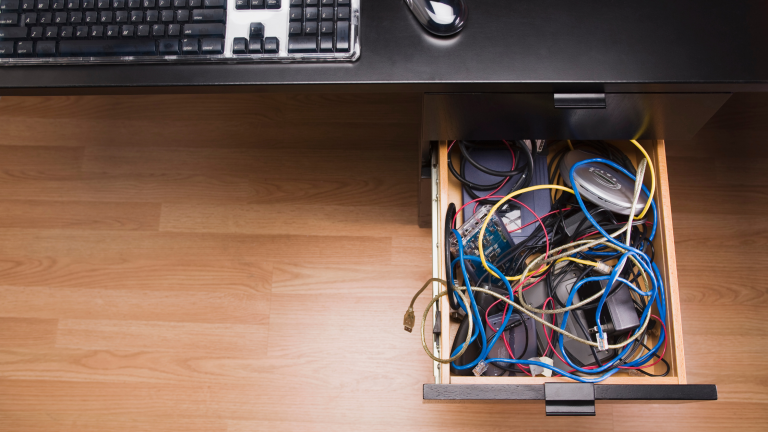
A drawer of chargers, a stack of tote bags, eleven black t-shirts: those are copies. The right move is a number, decided before you touch anything. How many do I need — two? Fine, two. The individual objects are nearly interchangeable, so meeting them one at a time buys you nothing and costs you eleven small arguments you’re likely to lose at 9pm.
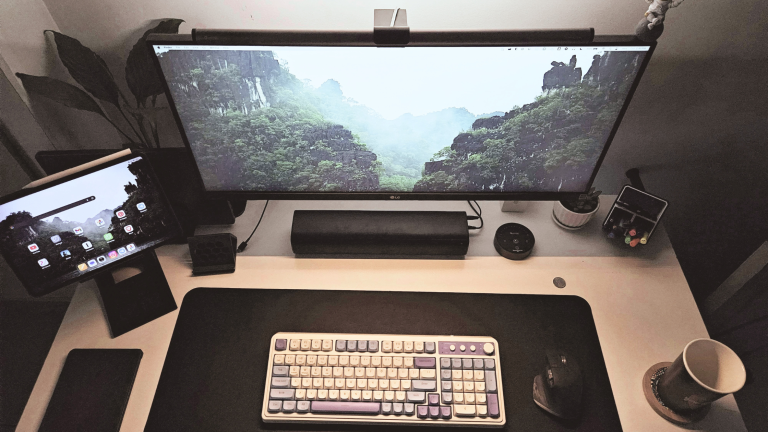
A desk is the other thing entirely. A desk is a lamp, a notebook, one specific pen, a cable to something, a thing your kid made, a charger. Nearly every object on it is a category of one. There’s no number to set. A pre-written list can’t anticipate that population, which is why every desk-clearing session run with a list in your head ends the same way — lifting things up and setting them back down without deciding anything. It’s the same principle underneath everything I write about making a room work rather than making it look tidy, and where you put the desk in the first place — every guide hands you a list of placement rules, and a real room makes two of them contradict.
For originals, the question that works is: if this weren’t here right now, would I go and get it? Not “will I need it someday.” Someday isn’t hard — it’s unanswerable, which is a different thing, and it’s why you can stand over a pile for twenty minutes and put everything back. You can’t lose an argument you can’t finish. But “would I walk to the drawer and retrieve this” is answerable in two seconds, because it asks about a real action by a real person in a real room. It takes about two minutes to run on a whole desk.
What my own desk actually produced
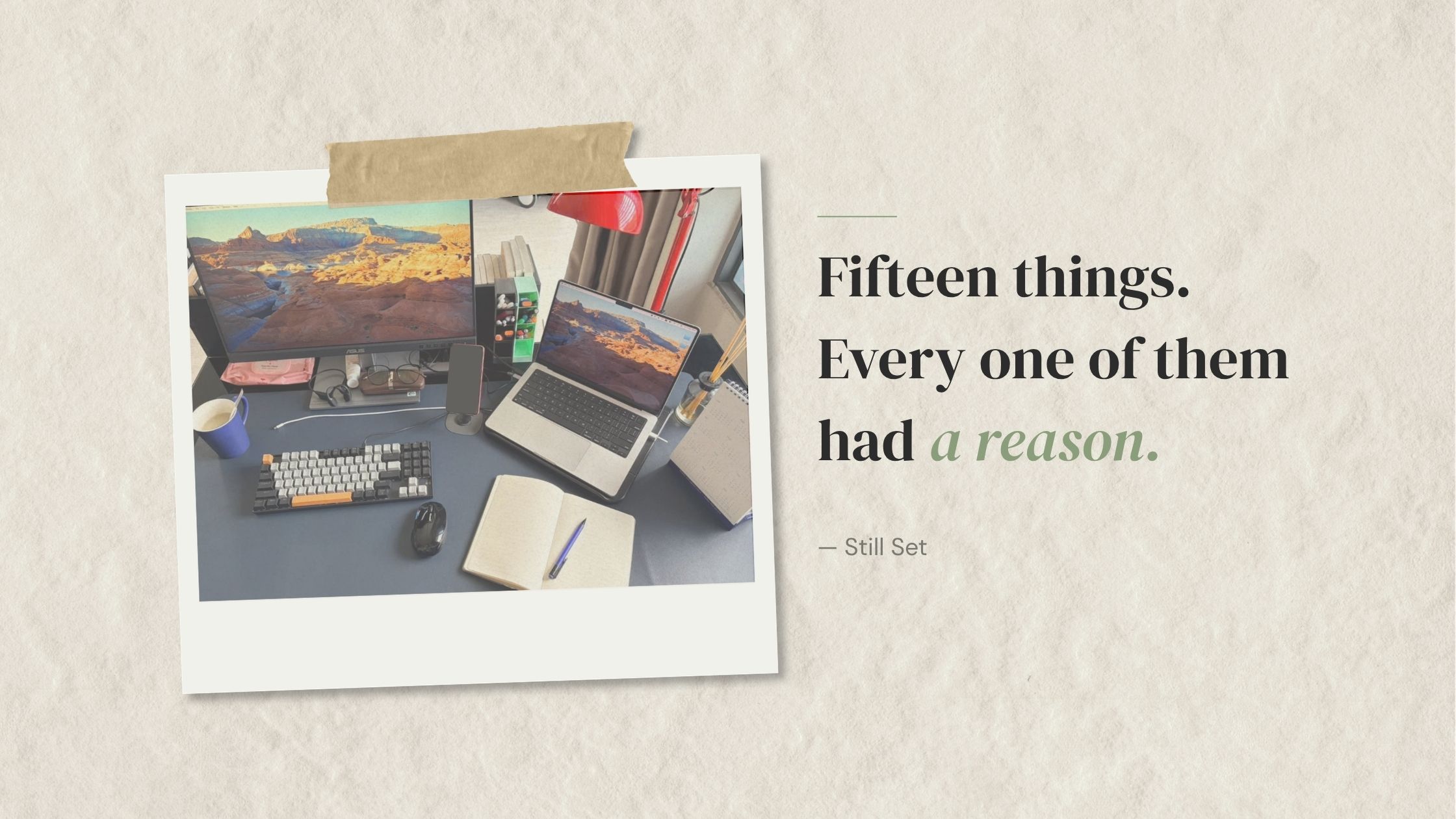
Fifteen objects. Three out immediately. Eight obvious keepers. Four I could not call either way.
That’s the whole result and I’m reporting it as data rather than as a story, because a sample of one desk is worth exactly one desk. What’s useful in it isn’t the eight or the three — those were never in doubt. It’s the four. Every method I’ve described produces a residue it can’t resolve, and how you handle the residue is where methods actually differ.
The residue needs a box, and where you put the box decides the answer
Unsure items go in a box with a date on it — and the box has to be out of sight but within about thirty seconds of reach.
The box isn’t my idea. It comes up constantly in decluttering communities and someone reading this has been doing it for years. What I think gets missed is placement. Not the loft. Not the garage. Not the car boot. If retrieval is a hassle, then not retrieving something proves the box was inconvenient — it doesn’t prove you didn’t need the thing. The point of the exercise is to find out whether you go back for it, so going back has to be easy, or you’ve built a machine that returns the same answer no matter what you put in it.
The other half is the date, and that’s where most people lose it, myself very much included. A box without a deadline is just a more respectable place to keep clutter — I kept one for the better part of a year and it never once left the closet.
Mine says the 28th. I’m publishing this before I open it, which means I don’t know whether my own four items will come back. That’s the honest state of it. — Still Set
The Desk Test
Mine says the 28th. Yours needs a date too.
The test builds the third list for you and comes back in 14 days to ask which of those items you went and got.
Neither method solves the money
The most common objection in every thread I’ve read isn’t “I might need it.” It’s “I paid for this, and throwing it out means I wasted the money.”
Set a number and you still have to bin the nine surplus chargers you paid for. Ask the question and you still have to bin them. Both methods sort by usefulness, and the thing actually holding the pile in place is cost. I don’t have a good answer to that and I’m not going to improvise one — it’s a different problem and it deserves its own treatment rather than a paragraph at the end of someone else’s argument.
So: if what’s in front of you is a stack of near-identical things, decide the number first and don’t negotiate with individuals — the list is genuinely the better instrument there and anyone telling you to abandon it hasn’t thought about copies. If what’s in front of you is a surface where nearly everything is one of a kind, put the list down and start picking things up.
And if you can’t tell which kind of pile you’re looking at, that’s the useful question, not a failure to answer it.
Update, 28 August: One of the four came back. Two didn’t. The fourth is still sitting in the box.
The charger came back on day one — I’d have walked over to get it, which is the entire test. The headphones and the tissues never moved, and they’re both in a drawer now. Neither failed on usefulness; both failed on frequency. I’d have sworn I reached for the headphones most days. I didn’t. And the tissue roll wasn’t there for tissues — it was there so the desk would look like a desk that gets wiped down. That’s a real reason to keep something. It just isn’t the reason I thought I had.
The notebook I’m leaving unresolved rather than rounding it up. I never went to get it, but “would I go and get it” is a question about retrieval, and what I want from a notebook isn’t retrieval. That’s a limit of the test, not a failure to run it properly. One in four is about the residue I’d expect any method to leave behind.
— Still Set
Try it on your own desk
What’s actually earning space on your desk?
Two minutes, one question, whatever is in front of you right now. You’ll end up with three lists — keep, go, and the one you couldn’t call either way.
No account, nothing saved, nothing to install.
Some posts on Still Set contain affiliate links. This one doesn’t — there’s nothing to sell around asking yourself a better question.