How to Focus While Reading (When Your Brain Has Nothing Left)
Last night I read the same paragraph four times. Not a difficult paragraph. A novel I actually like. Somewhere between the second and third attempt, my hand had already picked up my phone. I don’t remember deciding to.
If you’ve searched “how to focus while reading,” you’ve probably already read the standard advice. Put your phone in another room. Try the Pomodoro technique. Set up a cozy reading corner. Use your finger as a pointer. I’ve read those lists too. Some of them are twelve items long.
Here’s what none of them told me, and what took me embarrassingly long to figure out: my problem was never that I didn’t know how to focus. My problem was when I was asking my brain to do it — and what I was asking for.
Why can’t I focus when I read anymore?
The short answer: you’re probably not losing the ability to focus. You’re reading with whatever attention is left over after everything else has taken its share — and treating the book like one more task to perform.
Most nights, by the time I pick up a book, my brain has already run eight hours of screens and calls, a school pickup, dinner, and an hour of play and homework with the kids before their bedtime. Then I sit down at 9:30 p.m. and expect that same brain to hold forty-five minutes of sustained attention on a page. When it can’t, I don’t think “of course it can’t.” I think “what’s wrong with me?”
That second thought is the real damage. It’s how “I couldn’t focus tonight” quietly becomes “I can’t focus when I read anymore,” which becomes “maybe I’ve lost the ability to read.” I’ve watched that exact spiral in myself. It’s not a reading problem. It’s an accounting problem — the book keeps getting paid last.
There’s research behind how thin the leftovers are: attention researcher Gloria Mark found that our average attention on any single screen is now about 47 seconds (University of California, Irvine, 2023). A day built out of 47-second fragments doesn’t switch off at 9 p.m. It arrives at the book still twitching.
Do focus techniques for reading actually work?
Honest answer from Still Set: the standard techniques work for a brain that has attention available and needs help directing it. They mostly fail for a brain that has nothing left to direct — which is the brain most of us are bringing to the book.
I’m not against the classic tips. I set up a focus mode on my phone and gave the Pomodoro technique a fair shot. The focus mode helps at the edges. The timer mostly gave me one more thing to watch — I spent the intervals aware of the interval. And reading goals just turned a novel into a KPI. Reading the forums, I’m clearly not alone — people describe trying every technique on the internet and still bouncing off the page. The advice keeps prescribing more structure, more discipline, more system. Nobody asks whether the attention was ever there to be structured.
So I stopped asking “which technique am I missing?” and started asking a more useful question: what am I actually asking of my brain, and when?
How do I actually focus while reading? Shrink the ask.
What finally worked for me wasn’t a technique. It was three quiet changes to the deal I make with myself. At Still Set I keep coming back to the same move across everything — books, desks, tools — and it applies here too: stop trying harder, ask for less.
1. Make the ask smaller than feels respectable. I stopped sitting down to “read for an hour.” I sit down to read a few pages — sometimes one. If it becomes more, fine. Most nights it does. But the contract is small enough that my spent brain doesn’t refuse the meeting. A tired mind can’t promise a chapter; it can almost always manage a page. It feels almost insulting at first. It also works, which the respectable version didn’t.
2. Stop feeding the book your leftovers. Not every reading minute has to live at the end of the day. I’ve started moving some of mine to the ten minutes with my coffee before I open the laptop — before the day starts spinning. Ten minutes of front-of-the-day attention is worth more than forty at the bottom of the tank. The evening pages became a bonus instead of the whole plan — and oddly, they got easier once they stopped carrying it alone.
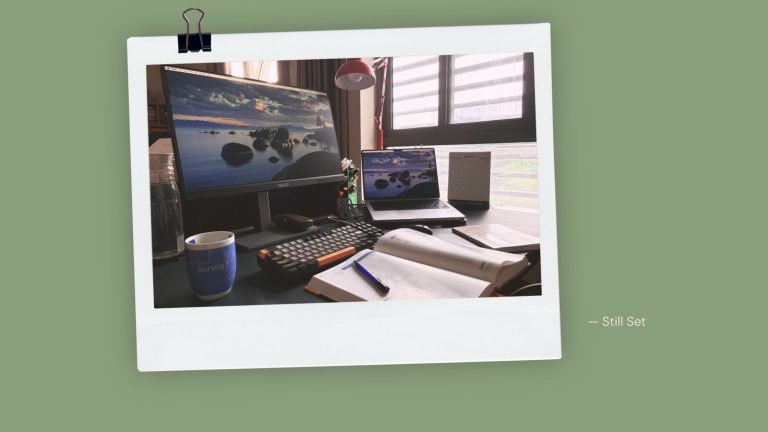
3. Take down the scoreboard. No page goals. No yearly count. No finishing deadline. I brought those metrics home from work without noticing, and they turned reading into one more performance review. This was half of what put me in a reading slump in the first place — and the pattern is bigger than books. It’s the same trap I fell into with my desk, which I couldn’t clear because I’d set standards designed for a person with more hours than me. The moment reading stopped being measurable, my attention stopped flinching from it.
Choosing what to shrink the ask WITH matters too; here’s the kind of book I reach for when attention is already spent. That’s the whole method. Nothing to buy, nothing to install — there’s no product link in this post because the honest recommendation here is fewer things, not one more.
Who this won’t help
Being upfront about the limits:
- If your attention has changed suddenly or severely — you can’t focus on anything, not just books — that’s a conversation for a doctor, not a blog post. This article is about ordinary depleted attention, not clinical territory.
- If you’re studying for an exam, you need retention tactics on a deadline. The gentle version above will feel too slow. (Though even then, the “stop feeding it your leftovers” part still applies.)
- If your reading time is genuinely zero — new baby, crisis season — the problem isn’t focus and no technique fixes it. Shelving the books for a while is a legitimate move, not a failure.
Where this left me
I’m three weeks into reading this way, so take this as a field note, not a victory lap. I still lose focus. The phone still wins some nights. But the paragraph-read-four-times spiral — the one that ends in “what’s wrong with me” — has mostly stopped, because the ask finally matches the attention I actually have.
And once you can stay on the page, a different question shows up: what do you do with what you read so it doesn’t evaporate by morning? That’s its own problem, and I wrote about it separately — how I stopped trying to remember everything I read. The handful that survived all of it live on the shelf I keep here.
If you’ve been stuck rereading the same paragraph lately: what time of day are you asking your brain to read? I’m collecting answers, because I suspect “9:30 p.m.” is doing more damage than any phone. Tell me in the comments.
— Still Set
One thing you can still decide tonight
Reading asks for attention you don’t have left. This asks for two minutes and one question.
Three lists, two minutes, and a box for the things you can’t decide about. We email you once on day fourteen to tell you what the box proved.
No account, nothing saved, nothing to install.