I Tried a Dozen AI Tools. My Real Stack Is Embarrassingly Small.
What I actually open every day — and the one I’m probably about to cut.
Last week I pasted a news article about a company’s founder into Claude and asked it to break down the business. A few minutes later I had the whole thing laid out in front of me: the flagship product, how the operation actually made money, where the risks were, what the results had been.
I sat there for a second, a little stunned. Researching a business used to mean reading a dozen scattered articles and still not being able to summarize it cleanly in my own head. Here it was, done, structured, in the time it took my coffee to cool. And it left me with a thought I keep coming back to: one tool used at the right moment can be worth more than a dozen vague ones combined.
But this isn’t a post about how amazing Claude is. It’s a post about the opposite thing — about how I finally stopped collecting tools.
The graveyard of apps I was supposed to love
For a long time I treated “being productive” as a shopping problem. If I was overwhelmed, surely the answer was the right app. So I kept installing them.
Evernote was supposed to be the one. Everyone said so. I lasted maybe two weeks. The free plan boxed me in fast, and more than that — I just never clicked with how it wanted me to think. Every time I opened it I felt like I was filling out a form instead of writing something down. So I deleted it.
Now? I use Apple Notes. The one that comes free on the phone I already owned. I know how that sounds in a post that’s supposedly about AI productivity. It sounds like giving up. But here’s what I’ve come to believe after all the deleting: the best tool isn’t the one with the most features. It’s the one you actually open. The one that’s already there when the thought arrives, before the resistance kicks in.
Apple Notes wins not because it’s powerful. It wins because there’s zero friction between me and it.
So here’s the whole stack. There are two things on it.
That’s it. After all the trial periods and the abandoned logins, my real working stack is two tools. I keep waiting to feel embarrassed about how small it is, and instead I mostly feel relieved.
1. Claude — the fog-clearer
This is the one I open every day. Not for writing, mostly — for thinking.
What it actually does for me is take something half-formed and hand it back with edges. I’ll dump a messy pile of thoughts about a project, the kind of thing that’s clear-ish in my head but turns to mush the second I try to explain it, and ask it to make sense of the mess. What comes back is a structure: here’s what you’re actually saying, here are the gaps, here’s the part you’re avoiding.
The business breakdown I mentioned at the top is the clearest example. I gave it raw material and got back something I could act on. That’s the feeling I keep coming back for — less like using software, more like someone smart wiping the fog off a window I’d been squinting through.
One honest note, since this is the kind of thing I’d want told to me: I don’t earn anything if you use Claude. No affiliate link, no commission, nothing. I’m telling you about it because it’s the tool I’d actually miss, not because it pays me to.
2. ChatGPT — the second opinion (on probation)
ChatGPT is maybe 20% of what I do now. I keep it around for cross-checking — when I want to see if a different model frames something differently, or for the lower-stakes questions I don’t want to clutter my main workflow with.
I’ll be honest: it’s on probation. I’m increasingly not sure it earns its keep alongside Claude, and I’m eyeing it as the next thing to cut to keep my costs lean. I haven’t pulled the trigger yet. But the fact that I’m even asking the question tells me something — a year ago I’d have kept paying for both just in case, the same way I kept installing apps just in case.
What I learned from the graveyard
I used to think the overwhelmed feeling meant I was missing a tool. It almost never did. The overwhelmed feeling usually meant I had too many — too many half-learned apps, too many places a note could live, too many decisions about where to put a thought.
The fix wasn’t a better app. It was fewer of them, used more deeply. That’s the thread behind everything in the small set of AI tools I actually keep here.
So no, I’m not hunting for the next thing anymore. Two tools, one of which is on its way out, plus the free Notes app I never have to think about. That’s the whole setup. It’s embarrassingly small, and it’s the most settled my work has felt in years.
If you’re standing in your own graveyard of abandoned productivity apps right now — I’d gently suggest the answer isn’t installing one more. It’s figuring out which one or two you’d actually miss, and letting the rest go.
That’s the part nobody selling you a tool wants to say out loud.
One more thing. If you’re in the middle of your own tool graveyard right now — which one keeps not sticking for you? Leave a reply below and tell me. I read every single one, and honestly, what people are actually stuck on is what tells me what to write next.
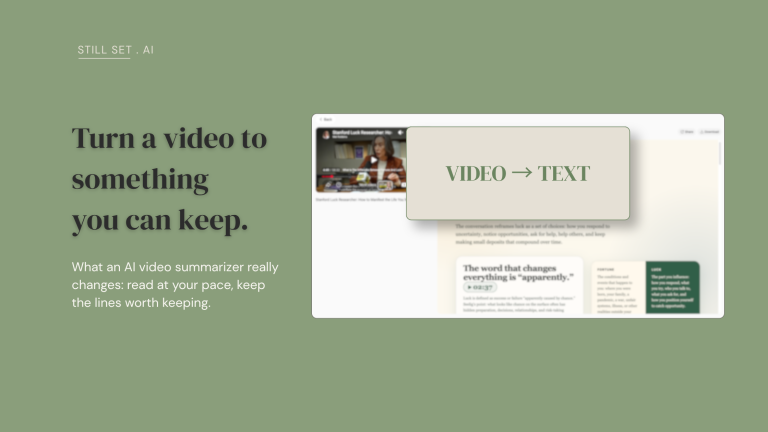
Coming next: I’m testing a couple of tools for specific jobs — including one for turning long videos and podcasts into text I can actually use. When I’ve used them long enough to have a real opinion, I’ll write it up properly.
A note on how I write these: I only recommend things I actually use, and I tell you plainly when I don’t earn anything from them (like Claude and ChatGPT — I don’t). When a post does contain an affiliate link, it’ll be marked, and it never changes what I’d tell a friend. — Still Set
The cut you haven’t made yet
You know which tools you actually open. Nothing on your desk has ever been asked that question.
Three lists, two minutes, and a box for the things you can’t decide about. We email you once on day fourteen to tell you what the box proved.
No account, nothing saved, nothing to install.