Everything on My Desk at Seven in the Morning, and What Each Thing Had to Beat
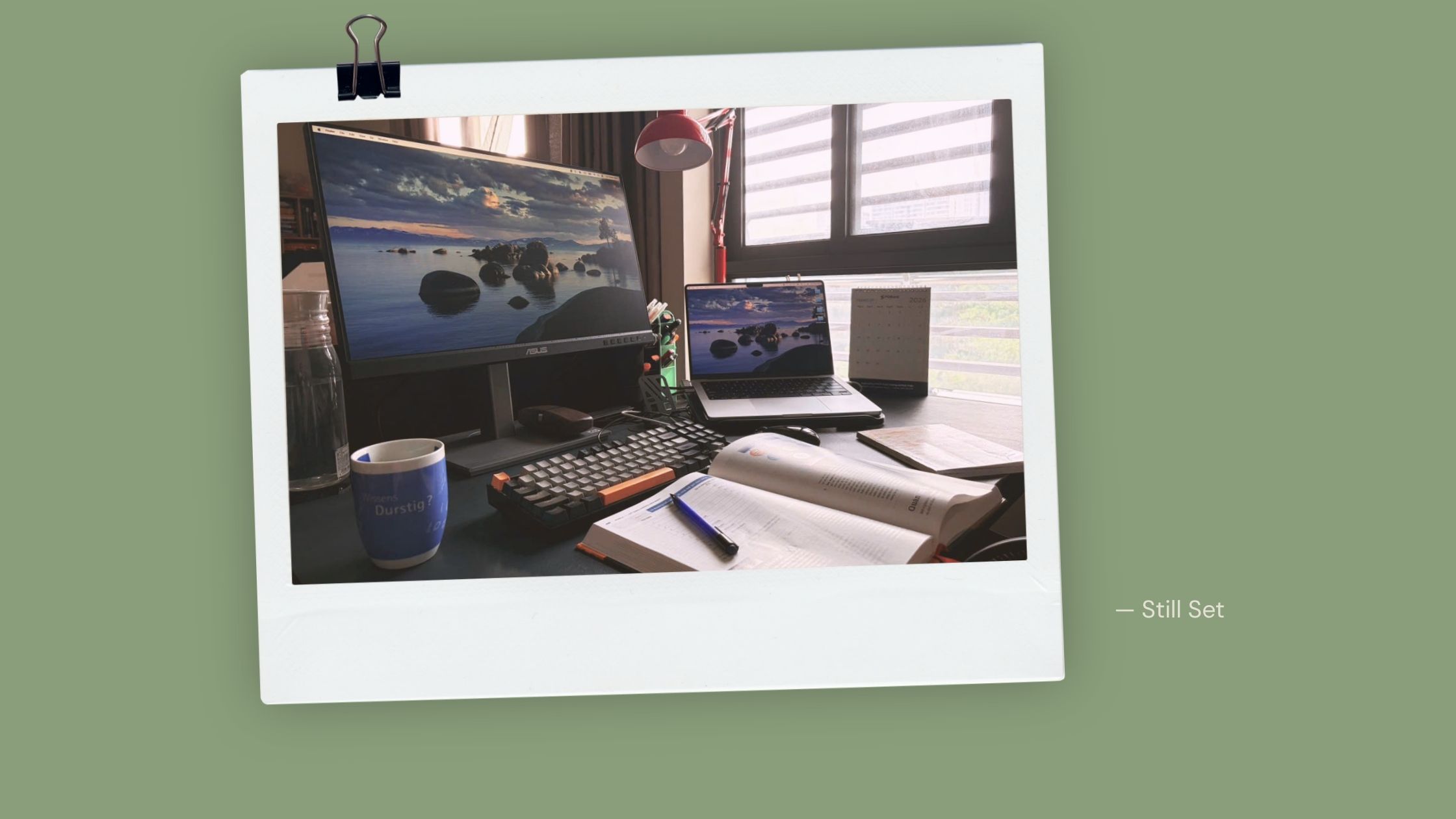
It is a little after seven and I have not started work yet. The blinds are half open, the light is coming in flat and low across the desk, and there are other people in the flat already, in the same room, each doing their own thing. Before I moved anything I took a few photographs, because the only honest answer to what’s on my desk is the one taken before I tidy it.
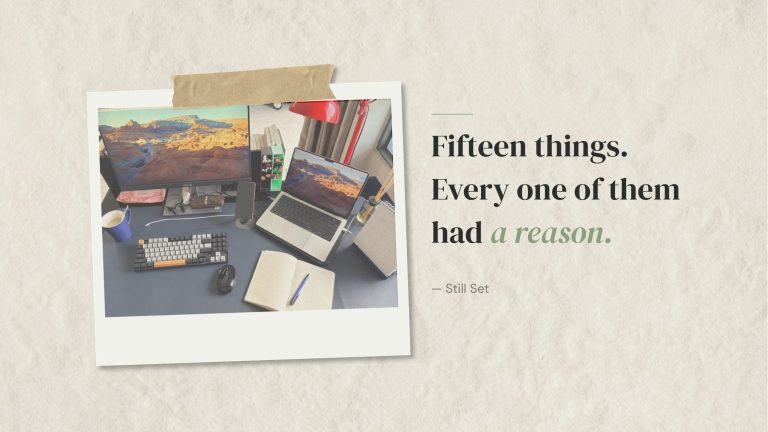
Fifteen things. I counted them off the photograph instead of from memory, and the number was higher than I would have said out loud.
What is on my desk right now?
A monitor, a laptop on a stand, a keyboard, a mouse, a mug, a glass water bottle, my glasses, a desk lamp, a charging cable, a phone stand, a pen tray, a reed diffuser, a desk calendar, one book, one notebook.
That is the whole inventory, and the interesting part is not the list. It is that I have an opinion about only seven of those fifteen. The other eight have never once come up for review, and until this morning I had not noticed that they were exempt.
Which things never come up for review?
The monitor, the laptop, the keyboard, the mouse, the mug, the water bottle, my glasses and the lamp have never been candidates for removal, because each of them is either the work itself or the condition for doing it.
I cannot argue about the monitor. There is no version of my day where the mouse is up for debate, and the glasses are not an object on the desk so much as a part of how I see the desk. The mug and the bottle are there every single day, in the same two spots, and the lamp is there because at certain hours the room simply is not bright enough.
Eight of fifteen, settled without a thought. Every desk audit I have ever read assumes you are weighing everything. You are not. You are weighing a minority, and that minority is where all the clutter lives.
Which object here has actually passed a test?
Only the charging cable, and it passed by making me walk to it.
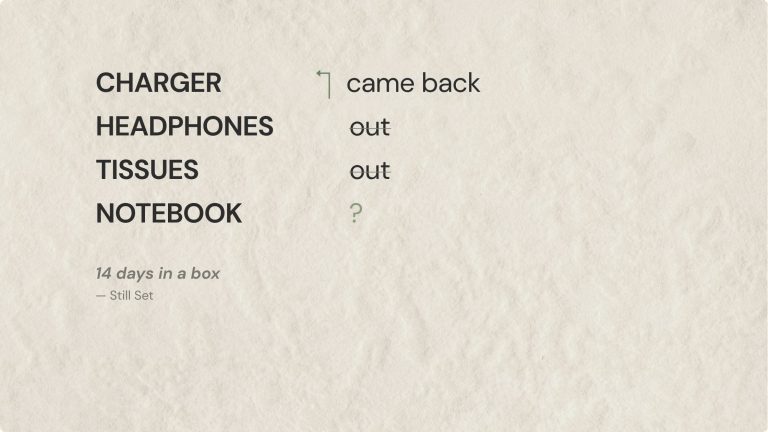
In August I put four things from this desk into a box for fourteen days and the cable was the one that came back. It came back because the phone has to sit within reach so I can pick it up the second something needs doing on it, and it kept being low, and I kept getting up to fetch the cable, and eventually the arithmetic settled the argument for me. The Desk Test is that question and nothing else: would I go and get this if it weren’t here. Fourteen days of my own feet said yes.
It is the only thing on this surface with a verdict attached. Everything else here is either exempt, or pending, or held on a feeling.
Why is there a phone stand next to a phone?
Because of a gesture that takes two seconds, and because that gesture happens many times a day.
The phone has to be looked at to unlock, and if it is lying flat on the desk I have to pick it up, angle it at my face, do the thing, and put it down again. In the stand it is already at the right angle, so the phone gets used without ever leaving its spot. That is the entire job.
The honest part: the stand is not really my object. It belongs to the phone. It arrived with the phone, it goes where the phone goes, and if the phone left tomorrow the stand would have no reason to exist. There is a difference between things I chose and things that came attached to something I chose, and the difference only shows up when you list the desk and notice you cannot remember deciding about one of the items.
The pen tray I nearly got rid of
I have considered removing the pen tray more than once, because it is not a thing I use. It sits there most of the day untouched.
What it does is not a use, it is a sort. The pens are separated by kind, so the one I want comes to hand immediately instead of after a rummage, and the reason I still have it is that I ran the alternative by accident. Without the tray the pens lie around the surface individually, and then the surface has six small objects on it instead of one, and a desk becomes a junk drawer exactly that way, one loose item at a time.
So it stays for what it prevents, not for what it does. That is a category I did not have a name for until this morning, and I suspect most desks have one or two of these: objects whose whole value is the mess that never happens.
The Desk Test
Most of your desk is exempt. The clutter is in the rest.
This walks your desk one object at a time and hands back three lists, including one for the things you are keeping on a feeling.
Which things are here on an expiry rather than a decision?
The reed diffuser and the desk calendar, and both of them will resolve themselves without me ever having to rule on them.
The diffuser is temporary by construction. It runs out. When it does I may replace it or I may not, and either way no decision has to be made on a Tuesday morning while I am trying to start work. The calendar is the same shape. It expires on its own schedule, and it can go at any point without anything being lost.
I find this genuinely restful. A desk audit teaches you to ask keep or throw about everything, but a small number of objects answer that question themselves if you let them run down. Nothing on my desk is more peaceful than the two things I am not required to have an opinion about.
Why is there a book on the desk today that will not be here on Friday?
Because it came out for a specific job this morning, and the job has an end.
I pulled it down today because I needed to look something up, and it will stay open on the right side of the desk for two or three days while I keep checking things in it, and then it goes back. It is on the desk the way a tool is on a workbench, which is to say not really on the desk at all. It is in use.
The trouble starts when the task quietly ends and the book stays. That is how most of the things I have ever had to clear away got there in the first place, and I only get to use this sentence confidently because it has happened to me many times and I recognise the shape now. The book is fine today. It is worth checking on Friday.
The notebook stayed
I decided to keep the notebook on the desk, and I want to be straightforward about the fact that I decided it against my own evidence.
The notebook was the fourth thing in the box in August, and it did not come back the way the cable did. Nobody fetched it. Fourteen days went by and it raised no signal at all, and when I opened the box I could not even recall it was in there. By the standard I apply to everything else on this surface, it had failed.
It is on the desk anyway. What won was the feeling of having what I need within reach, and the belief, which I still hold, that I will open it and write something in it. That is not a use. It is a state I would like to be in, and I cannot produce a single piece of frequency data to defend it.
I am leaving it there, and I am leaving this paragraph here too, so that neither of us pretends the decision was rigorous. You keep some objects for the work they do. You keep others for the person you are still intending to be, and Still Set has no test for the second kind. The box measures reaching. It has never had anything to say about intending.
What is not on my desk, and why?
There is no plant, and a plant is the thing most desks like this one have.
I wanted one. The idea of a small green thing in the corner of the desk is genuinely appealing, and the evidence is not on my side here: Nieuwenhuis, Knight, Postmes and Haslam published three field experiments in the Journal of Experimental Psychology: Applied in 2014 in which offices enriched with plants showed productivity roughly fifteen percent higher than the same offices stripped bare. I know this and I still do not have a plant.
Three reasons, in order of how much they embarrass me.
The plants I tried did not do well in this room, sitting near the electronics, and I cannot honestly tell you whether that is the room or whether it is me not knowing how to look after them.
The plant became an errand. When I got stuck on something difficult, the plant was right there, and it always had a small legitimate job available: water it, pinch off a dead bit, pick out the debris on the soil. Twenty minutes later I would still be stuck, only further from the screen. The tasks that look like work are the ones that cost the most, and a living thing on the desk is the most defensible interruption ever invented, because you can always say it needed doing.
And the window already does it. The desk sits beside the window with my back to the wall, facing into the open part of the room, and what is out of that window is trees. The green is already in the room. Putting a small pot of it on the desk would be buying something I can see for free from where I sit, which is also the thing that finally settled where this desk goes.
What can a snapshot like this not tell you?
It cannot tell you whether any of these objects deserves to be here. It only tells you which ones I have stopped asking about.
One morning, one desk, one person. The eight exempt items are exempt because I have not questioned them, and unexamined is not the same as earned.
A photograph taken before tidying is still a photograph taken on a day I knew I would be looking. It is more honest than a staged desk and less honest than a hidden camera.
Everything in the drawers and everything on the floor is outside this count, and a desk can look resolved while the decisions sit six inches below it in a drawer.
And none of this is a recommendation. My phone stand exists because of how my phone unlocks. My pen tray exists because of how my pens behave when it is gone. Neither fact travels.
The one thing I would take from it is the proportion. Fifteen objects, eight never in question, one with an actual verdict, two that will expire on their own, one on a task, two doing quiet preventative work, and exactly one held purely on a feeling. That last one is the only real decision on the desk, and it is the one I have not made.
— Still Set
Your own fifteen
Count your desk before you tidy it.
Three lists, two minutes, and one list for whatever you are keeping on a feeling. We email you once, on day fourteen, to ask what you went back for.
No account, nothing saved, nothing to install.