I’m a Slow Reader Trying to Read More. So I Did Something a Little Embarrassing.
I read slowly.
Not “I wish I read more” slowly. I mean I can sit with a book for thirty minutes and realize I’ve read the same paragraph three times because my mind wandered off to something I forgot to reply to. I’ve been like this for more than two years. Long enough that I stopped calling it a phase.
Here’s what that actually looks like on my shelf: Deep Work and Atomic Habits, both bought with real intention, both with a bookmark stuck somewhere around the first quarter. I didn’t dislike them. I just never came back. They’re both still on the shelf I keep meaning to get through.
For a while I told myself the problem was the books. Wrong genre, wrong timing, too dense. Then I noticed the pattern was me, not them. I’m good at buying books. I’m good at the ten-minute high of adding one to the cart, imagining the version of myself who finishes it. The reading is where I fall off.
So a few weeks ago I tried something I’m slightly embarrassed to admit.
I made myself financially responsible for my own reading
Here’s the full honesty, and it’s the whole point of this post: I run this site, and some of the book links here earn me a small commission. Which means when I buy a book through my own link, a few cents of my own money loops back to me. It’s a rounding error. It changes nothing about my finances.
But it changed something small in my head.
I started buying the books I actually want to read through my own links — on purpose. Not because the commission matters. Because the act of doing it makes the book feel like a tiny piece of work I’ve committed to, not just another impulse buy. I’m now mildly, stupidly accountable to it. If I don’t read the thing, I’ve quietly let down the one person who recommended it: me.
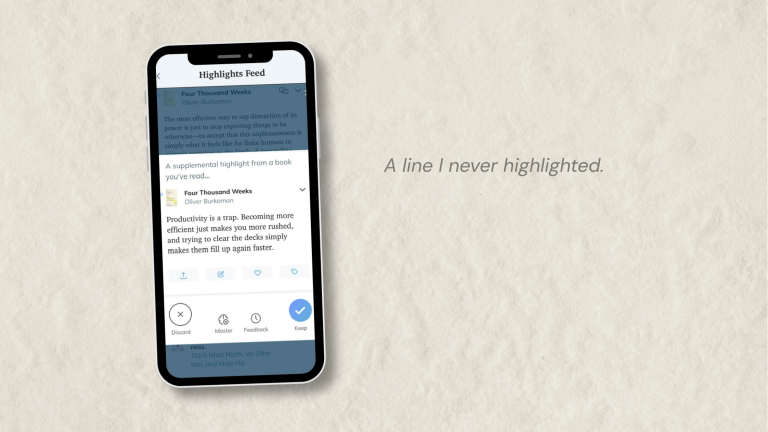
The first book I’m testing this with is Four Thousand Weeks: Time Management for Mortals by Oliver Burkeman, $17.71 on Bookshop. A line from that book I never even highlighted ended up changing how I read. I’ll tell you in a few months whether I finished it.
The part where I tell you this is probably a bad idea
I’m not going to pretend this is a system. Here’s the obvious flaw, and I’d rather say it than have you think it: buying a book has never once made anyone read it. There’s a Japanese word, tsundoku, for exactly this — the pile of bought-but-unread books that quietly judges you from the shelf. Adding a financial twist doesn’t fix the actual problem, which is attention, not ownership.
So why do it at all?
Because I’ve tried the “real” advice. Read 10 pages before bed. Join a book club. Track it in an app. Set a yearly goal. None of it stuck, because all of it felt like one more task on a list I’m already drowning under — the same trap I wrote about when I stopped trying to be productive. This thing is different in one specific way: it’s small, slightly silly, and mine. It doesn’t ask me to become a disciplined person overnight. It just adds a small, real weight to a decision I was making anyway.
Whether that’s enough — I don’t know yet. That’s the honest answer.
What I’m actually changing alongside it
The money trick is the hook, but I paired it with two boring things that I suspect matter more:
I stopped trying to read at night. Turns out by 10pm my brain is done, and I was treating the hardest cognitive task of my day like a wind-down activity. I moved reading to thirty minutes with my morning coffee, before I open anything with a screen.
And I let myself quit books. The two abandoned ones on my shelf? I’m not finishing them out of guilt. A book I’ll never reopen isn’t a debt. Permission to quit a book turned out to be permission to start a different one.
Where I am right now
I’m almost two weeks into this. I’ve read more in those two weeks than in the months before it. That could be the trick working. It could just be the novelty, which always fades. I genuinely can’t tell yet, and I’d be lying if I dressed it up as a breakthrough.
What I can tell you is this: I’ll be writing the follow-up to this post in a few months — the “did it actually work” version. If it didn’t, I’ll say so here, plainly. That’s the deal I’m making with you, same as the one I’m making with myself.
If you’re a slow reader too, I’d genuinely like to know one thing, because I’m collecting these for myself as much as anyone: what’s the actual reason you stop? Not the reason you tell people — the real one. Mine was that I treated reading like homework. Tell me yours in the comments.
The rest of what’s on my shelf →
— Still Set.
Same habit, different surface
A shelf holds books for the reader you meant to become. A desk holds things the same way.
Three lists, two minutes, and a box for the things you can’t decide about. We email you once on day fourteen to tell you what the box proved.
No account, nothing saved, nothing to install.
Some links in this post are affiliate links, which means I may earn a small commission if you buy through them — including, apparently, when I buy through my own. It costs you nothing extra. I only link books I’ve actually bought or am actively reading.