Is Readwise Worth It If You’re Not a Power User?
A few mornings ago I opened my daily review and stopped on this:
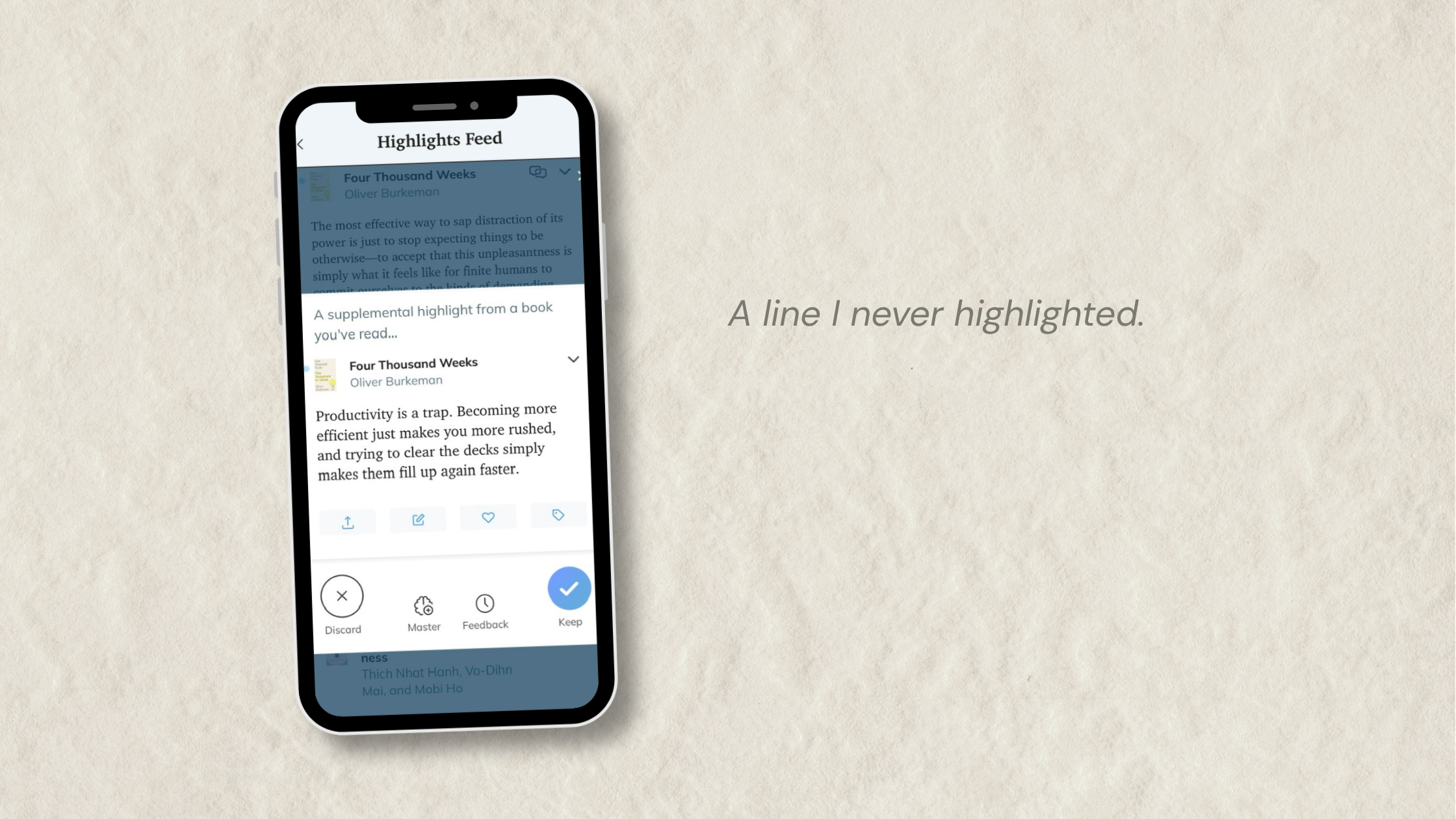
“Productivity is a trap. Becoming more efficient just makes you more rushed, and trying to clear the decks simply makes them fill up again faster.” — Oliver Burkeman, Four Thousand Weeks
Here’s the strange part. I didn’t highlight that line. I’ve been slowly working through that book for months, and I never marked that passage. Readwise showed it to me anyway — pulled from other readers’ highlights of the same book, surfaced into my morning like someone had left it on my desk.
I sat with it for a minute. Then I copied it into a note, because it says the thing I’ve been circling around for a year without finding the words for.
That’s the moment I stopped wondering whether this app was worth $5.59 a month.
But I want to be careful here, because that sentence is exactly the kind of thing every review says, and most of those reviews are written by people with ten thousand highlights and a Notion database with seventeen linked tables. I am not that person. If you’re reading this because you’re standing at the checkout page trying to decide, what you probably need isn’t another enthusiast. You need someone closer to your own situation to tell you honestly where the line is.
So: I’ve been using Readwise for three weeks. Here’s what I found, including the parts that would make me tell some of you not to bother.
What is Readwise actually doing?
Readwise collects the passages you highlight while reading — from Kindle, from articles, from wherever — into one place, then emails you a handful of them each morning to re-read. That’s the core of it. Everything else is built around that loop.
The pitch sounds mechanical when you write it out. It didn’t click for me until I thought about why we highlight at all.
Here’s my theory, and it’s the reason I ended up paying: highlighting isn’t really about the sentence. It’s about catching the feeling you had at the moment you read it. Something lands, something rearranges slightly in your head, and you drag your finger across the line to hold onto it. What you actually want later isn’t the text. It’s that feeling again — the one that reliably disappears the moment you close the book and go back to answering emails.
Readwise is a bet that showing you the sentence again brings back some of the feeling. Sometimes that bet pays off. Sometimes it very much doesn’t, which I’ll get to.
The problem it solves is one I already had a bad solution for
Before this, my system was screenshots.
Something good would go past — a line in an article, a paragraph in a book, someone’s post — and I’d screenshot it. The logic was always the same: I’ll come back to this.
I never came back to this.
What I built instead was a graveyard. Thousands of images sitting in a camera roll I only open to delete things when my phone starts complaining about storage. Every one of them was a small promise to my future self, and I broke every single one. The screenshots weren’t the problem, though. The problem was that saving something and revisiting something are two completely different activities, and I’d only ever been doing the first one while telling myself it counted as both.
That’s the actual job Readwise does. Not storage — I already had storage. The revisiting. Handing that off to something built for it means my head is lighter, my phone is lighter, and the things I saved have some chance of surfacing again.
Is Readwise worth the money?
Readwise has no permanent free plan — there’s a 30-day free trial, and after that you’re choosing between paid tiers. Lite runs $5.59/month billed annually, and the Full plan is $9.99/month annually — $119.88 a year — or $12.99 month-to-month. The Lite tier doesn’t include Reader, Readwise’s separate read-later app; that’s bundled only with Full.
I’m going with Lite. I want to explain why, because this is where I part ways with most of the reviews I read while deciding.
Here’s my honest usage after three weeks. Three things I use constantly:
- Daily review — the morning email and the app, which is the whole reason I’m here
- Browsing and searching my highlight library — surprisingly useful once there’s enough in there
- Automatic syncing from Kindle — I highlight while reading and it just shows up, no effort
And three things I’m paying nothing for, because I don’t need them:
- Tags and organizing — I don’t have enough highlights to need a filing system. Building one now would be organizing an empty room.
- Export to Notion, Obsidian, and the rest — I’m still deciding whether I even want to use Notion. Exporting to a system I don’t have isn’t a feature, it’s homework.
- Reader, the reading app — I read on Kindle and it’s fine. For everything else I use the Readwise browser extension or paste text in directly.
That’s the whole case. Nearly every review I read assumed I’d want Full, because nearly every reviewer is running a personal knowledge management system and Readwise is the spine of it. If that’s you, ignore me — you know what you need. But if you’re a normal person who reads a few books and wants to not forget all of them, the $5.59 tier is very likely the correct answer, and nobody seems to say that out loud.
There’s a benchmark floating around that’s worth knowing: if you make fewer than five highlights a week during your trial, the annual plan is hard to justify. I think that’s roughly right, and I’d add something to it below.
The feature nobody told me about
The Burkeman line at the top came from supplemental highlights — Readwise pulling passages that other readers marked in a book you’ve flagged interest in. I hadn’t seen this mentioned in any review I read before signing up.
It works on any account tier, and it’s in the mobile app too, under Add Highlights → Supplemental Books. You can add your own notes to someone else’s highlight, and those notes stay private to you — you’re annotating your copy, not theirs. Readwise will also send you new supplemental highlights for a book as they appear.
Two ways I’ve actually used it. First: reading other people’s highlights from a book before buying it, which tells you more about whether a book is for you than any review does — you’re seeing the actual sentences that made real readers stop. Second: getting the shape of a book I’m probably never going to read cover to cover. That’s a slightly guilty use case and I’m going to admit it anyway.
Where it doesn’t work
Some highlights come back completely dead.
This is the honest limit of the whole idea, and it’s the thing I’d most want to know before paying. A highlight shows up in my morning review and I look at it and feel nothing. Worse, sometimes I can’t even reconstruct why I saved it — I don’t remember the chapter, the argument around it, or what I was thinking. The sentence sits there stripped of everything that made it matter.
The theory says the highlight brings back the feeling. In practice, it only works when the sentence carries enough context to stand on its own. Plenty don’t.
I’ve changed how I highlight because of it. Now, when I mark something, I spend an extra few seconds adding a short note underneath — where this came from, why I stopped here, what it connects to. Not an essay. A fragment. But it’s the difference between a line that reactivates something three weeks later and a line that’s just words.
Which means the honest version of the value proposition is: Readwise doesn’t preserve your thinking. It preserves what you were willing to write down. If you highlight passively and expect the app to do the rest, you’ll get a stream of orphaned sentences and conclude the whole thing is overrated. That’s a fair conclusion from that behavior.
The daily reminder is relentless.
It arrives whether or not you want it. If you’re someone who’s actively trying to reduce the number of things pinging at you, be aware you’re adding one.
I don’t open it on Saturday or Sunday. Those days are family, and I’m not opening anything that feels like work. The email still comes. I’ve made peace with it by planning to open one review on Sunday evening instead — a soft way into Monday rather than an obligation across the weekend. But if daily notifications genuinely irritate you, this will irritate you daily.
Statistics is noise if you’re trying to read less anxiously.
Readwise will show you charts of your reading activity. For a certain kind of user this is motivating.
For the kind of person Still Set is written for — someone trying to get out from under the feeling that reading needs to be optimized — it’s the opposite. Turning reading into a metric is precisely the trap Burkeman is describing in the line at the top of this post. There’s a real irony in an app surfacing that quote to me on one screen and offering to chart my reading productivity on another.
I ignore that tab. I’d suggest you do too. But if you’re the kind of person who’ll end up checking a streak and feeling bad on the days it breaks, that’s a genuine reason to skip this app entirely, and I’d rather say so.
Who this is not for
Skip Readwise if:
- You highlight rarely. Under five a week and there’s nothing for the review to surface. The app has nothing to work with and neither will you.
- You read mostly physical books and don’t want to type. Readwise has ways to handle this but they all add friction, and friction is what kills the habit.
- You want notifications to decrease, not increase. This is one more daily thing.
- You measure yourself against your own metrics and lose. The stats will find you.
- You want an app that makes you remember without changing anything about how you read. It doesn’t work that way. The app surfaces; you still have to stop and read the thing.
Who this is for
Buy it if you read regularly on a Kindle or in a browser, highlight because something in you says hold onto this, and have quietly noticed that you can’t recall a single specific idea from the last book you finished. That gap between reading a lot and retaining a little is the entire problem this solves, and it’s a real problem — the same one I’ve been circling in a lot of what I write here.
Start with the trial, and use my link if you’re going to — it gives you a second free month on top of the standard thirty days. I’d take it even if I earned nothing from it, because one month isn’t really long enough to know. The first few weeks of any new app are novelty, and novelty always works. It took me nearly three weeks before the daily review stopped being a thing I was trying and started being a thing I opened. Two months gets you past that and into an honest answer.
Highlight normally during it. Don’t try to be impressive. At the end, look at two things: did you actually open the daily review, and did anything in it ever make you stop. If yes, Lite is probably enough. Full is for people who already know they’re building a system.
Where I am with it
Three weeks in, I’m going to pay for Lite when the trial ends. That’s an honest verdict but I want to be precise about how much weight it carries: three weeks is three weeks. I’m not going to tell you this survived a year, because I don’t know that.
What I can tell you is that the morning review is the only app notification I currently open on purpose, and that one line I never highlighted has been sitting in my head for four days. For $5.59 a month, that’s a fair trade. The lines worth that trade end up on the books that changed how I think — the short list I actually keep.
The thing I’d hand you if you take nothing else from this: write the note when you highlight. Ten seconds. It’s the difference between the app working and the app being an expensive graveyard with better lighting than your camera roll.
If you’ve been using Readwise for longer than me, I want to know one thing specifically, because it’s the question I can’t answer yet: did the daily review survive past the novelty, or did it become another unopened email? Tell me in the comments. I’ll write the follow-up either way.
I use Readwise myself and pay for it. Some links in this post are affiliate links — the same link that gives you an extra free month also earns me a commission if you subscribe, at no extra cost to you. I signed up and used it for three weeks before writing a word of this, and I’ve said plainly above who shouldn’t buy it.
— Still Set