Productive Procrastination: 5 Things I Did to My Desk to Avoid One Piece of Work
There is a piece of work I put off for most of this year. I can date the whole thing by what happened to my desk.
Productive procrastination is the version of avoidance that leaves evidence behind. You don’t scroll. You don’t nap. You do something genuinely useful, feel the small honest satisfaction of having finished it, and go to bed having not touched the thing. The internet has decided that a cluttered desk causes procrastination and that organising it is the cure. I would like to enter five pieces of evidence for the other direction.
What is productive procrastination, and why is a desk the perfect place for it?
Productive procrastination is avoiding a high-stakes task by doing lower-stakes tasks that still feel like work. A desk is the ideal venue for it because desk work is visible, finite and finishable — everything the avoided task is not.
The work I was postponing had no clear edges. I didn’t know how long it would take or whether it would be any good. My desk, by contrast, offered a dozen problems I could fully solve before lunch. Of course I picked the desk. Anyone juggling client work, a household and a brain that has quietly started dropping things would pick the desk.
Here is what that looked like, in order.
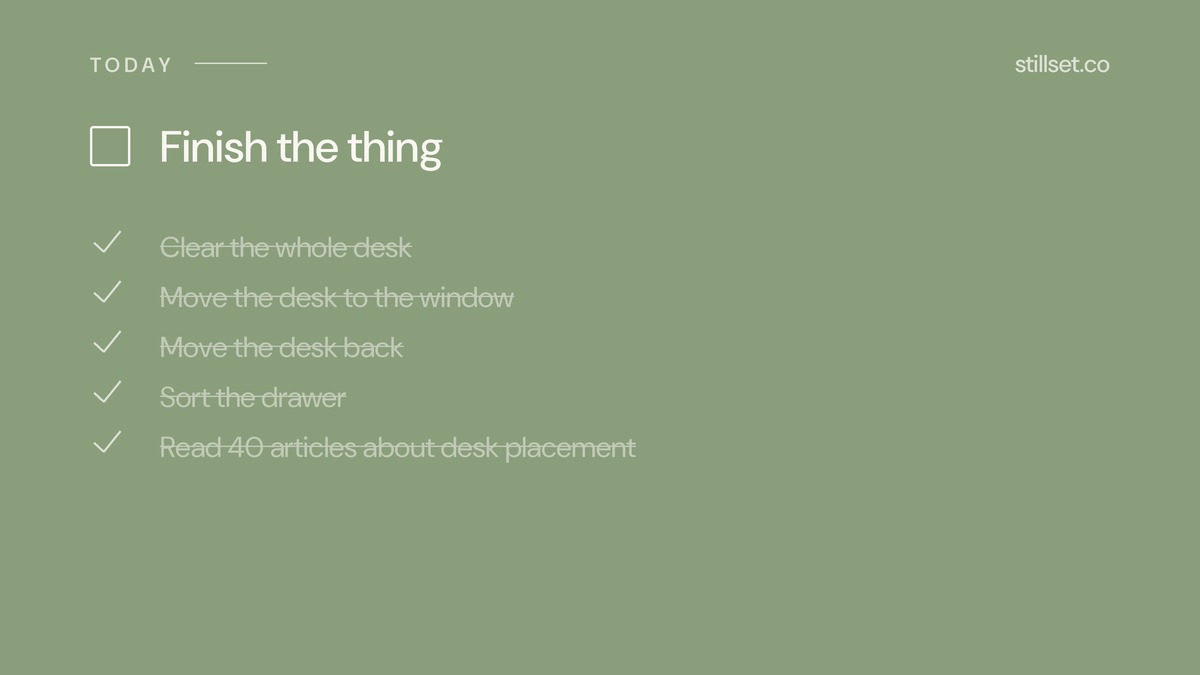
1. I cleared the entire surface. It lasted less than a week.
This one felt the most like progress and produced the least.
Everything came off. I wiped the wood. I put back three objects and stood there admiring a desk that looked like a photograph of a desk. It was genuinely nice.
Within a week there were eleven things on it again and I had not started the work. The clearing hadn’t been a system, it had been a mood. I wrote the longer version of why that keeps happening — the short version is that a cluttered desk is a deciding problem dressed up as a tidying problem.
What it postponed: the same one thing.
2. I turned the desk to face the window. That lasted about a week too.
Every guide on the internet told me to do this, which made it feel like research rather than avoidance.
For a few days it was lovely. Then the afternoons started, the glare arrived, and I discovered that a bright rectangle just past your monitor is not a view, it’s a competitor. I moved it back, and then moved it again.
The reason this one works so well as procrastination is that it’s effortful. You move furniture. You crawl under the desk to unplug things. You’re sweaty afterwards. Nothing that leaves you sweaty feels like avoidance.
What it postponed: the same one thing.
3. I divided the drawer into compartments.
This is the mature-sounding one, and it collapsed fastest.
Compartments assume you have already decided what belongs in each. I hadn’t. So within a fortnight the drawer was several smaller versions of the same drawer, and I had spent an evening arranging cables into a shape.
The actual fix, when I eventually got to it, was much less interesting: every object on the desk needs one home, decided once.
What it postponed: the same one thing.
The Desk Test
Compartments only help once you’ve decided what goes in them.
This asks you the same question about each thing on your desk and hands back three lists — including one for the things you couldn’t call either way.
4. I made a donate box.
A donate box is procrastination with a moral bonus, which is the strongest kind.
I filled it. I felt good. I put it by the door. It stayed by the door for a length of time I have written about elsewhere and would rather not restate, because the box stopped being a decision and became furniture.
The thing about the donate box is that it is a real task and it did need doing. That’s what makes this category so hard to catch. It’s not that the work is fake. It’s that the work is real and also, at that particular hour, not the point.
What it postponed: the same one thing.
5. I read about forty articles on where a desk should go.
This is the purest specimen in the collection, because it produced no change to the room at all.
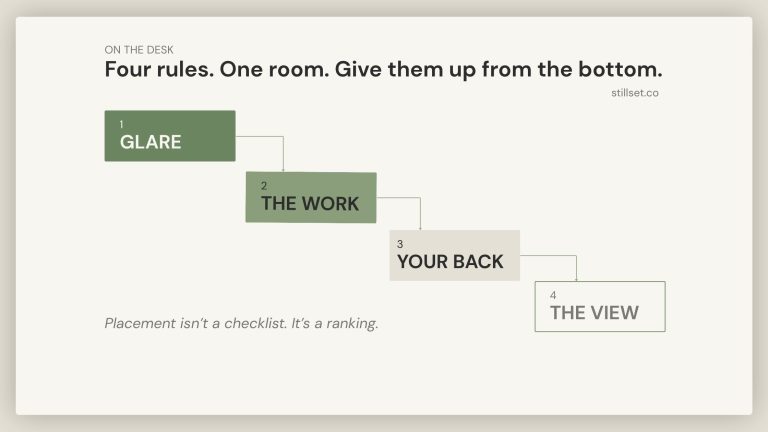
An entire Saturday afternoon of reading about window angles, door sightlines and command positions. Notes taken. Nothing moved. Nothing decided. I did eventually work out an order for making those decisions — glare first, then the work, then your back, then the view — but that came months later, and it came from moving the desk three times, not from reading about it.
Research is the most convincing form of productive procrastination because it produces a document. You can show someone the notes. The same thing happens with software — I’ve written about the year I spent collecting productivity tools instead of doing the work they were for.
What it postponed: the same one thing.
So what was the one thing?
A small tool that asks you one question about each object on your desk, and hands back three lists.
That is the joke I did not notice while it was happening. For months I cleared surfaces, moved furniture, sorted a drawer and filled a box — and the work all of that was postponing was the thing designed to make those decisions properly, once, instead of on a loop.
I want to be accurate about this: at no point did I stand in the room thinking how ironic. It didn’t occur to me until much later, writing this. That’s the whole nature of the problem. The avoidance doesn’t announce itself, because everything it makes you do is defensible. Five useful afternoons, one unstarted task, no guilt at any point.
It’s finished now. It took a fraction of the time the avoidance did.
How do you tell real desk work from avoidance?
One question, and it has caught me every time: would I be doing this on a day with nothing due?
That’s the whole test. Clearing the desk on a Sunday with an empty week ahead is maintenance. Clearing the desk at 2pm on a Tuesday with a draft outstanding is a symptom, and a symptom is worth reading rather than obeying.
The second question, for when the first is too easy to argue with: how long has this specific desk problem existed? If the drawer has been a mess since March and became urgent this morning, the drawer is not what changed.
None of this means you should force yourself to work at a bad desk. Still Set exists because the room genuinely does matter — light, placement, what sits on the surface, all of it does real work on your day. The point is narrower: the urge to fix the desk and the need to fix the desk arrive at completely different times, and only one of them arrives with a deadline attached.
Doesn’t research say clutter causes procrastination?
It says the two show up together. It does not say which one causes the other — and the advice built on it assumes an answer nobody actually has.
A 2018 study led by Joseph Ferrari found that people who score higher on procrastination also report more clutter and more trouble with excessive possessions. That finding is real and it gets quoted constantly, almost always with an arrow drawn in one direction: the mess came first, so go and clear the mess.
Look closely at what that prescription tells you to do. It tells a person who is avoiding a task to go and tidy. If there is anything to this article at all, that is the avoidance itself — and it has now been handed back to them as a remedy, with a citation attached.
The correlation survives the other reading intact, because a desk can be heavily tidied and still be cluttered. Those aren’t opposites. The desk in item one was cleared to bare wood and it is cluttered again now — not because I never tidy it, but because the tidying happens whenever something is due rather than whenever the desk needs it. A room maintained on the avoidance schedule looks messy in a survey and feels busy from the inside.
The study measured how much clutter people live with. It did not measure when they clean. Until something does, both readings fit the same numbers, and only one of them is getting printed.
What this doesn’t fix
This is a diagnosis, not a method, and there are places it doesn’t reach.
It doesn’t apply when the desk problem is acute — a chair at the wrong height, a screen you’re squinting at by three o’clock. Pain is not procrastination. Fix it and don’t philosophise about it.
It isn’t a way to feel worse about yourself, and if that’s the only thing it gives you, put it down. It also doesn’t touch why the work was frightening in the first place, which is the actual problem, and which a desk has never once solved.
Where I ended up
The tool got finished on a morning when the desk was in a state I would not photograph. Eleven objects. Two mugs. The good light on the wrong side, because I hadn’t moved anything in weeks.
Which is the part I keep having to relearn: the desk was never the bottleneck. The months I spent proving that were not wasted, exactly — they just cost considerably more than reading one honest article would have.
— Still Set
The thing I was avoiding
This is the tool all that tidying was postponing.
Three lists, two minutes, and a box for the things you can’t decide about. We email you once on day fourteen to tell you what the box proved.
No account, nothing saved, nothing to install.