I Moved My Desk to Face the Window. Then I Moved It Twice More.
For a while I believed the internet on this one. Every home-office article I read said the same thing, in the same confident voice: don’t shove your desk against a wall like a cubicle — turn it to face the window. Natural light. A view to rest your eyes on. Better mood, better focus. It sounded obviously right, the way things sound right when forty articles all say them.
So I moved my desk to face the window.
And for about a week, it looked wonderful. The desk caught the morning light. The whole surface looked clean and bright in a way it never had against the wall. I’d sit down and feel, for a moment, like someone who had finally figured out how to have a workspace.
Then the actual days started happening.
What facing the window actually did
Facing a window sounds restful in theory and is surprisingly demanding in practice. Here’s what I ran into, in the order I ran into it.
First, the light. All that lovely brightness was now coming from directly in front of me, behind my screen — which meant I spent the day squinting slightly at a monitor with a bright rectangle glaring right past it. It looked airy in a photo. On my eyes, by mid-afternoon, it just ached.
Then the view did the thing the view is supposed to do — and that turned out to be the problem. The advice is right that looking up from a screen to something green and far away rests your eyes. It genuinely does; I’d glance out at the trees and feel my shoulders drop. But a real window isn’t a calm painting. It’s a live feed. Someone walks past. A bird lands. A delivery van does a three-point turn. And I’d catch myself not resting my eyes so much as not wanting to look back at the screen at all. The window stopped being a place to rest and became a place to escape to.
And the last one I didn’t see coming. Because I now had a nice open view in front of me all day, I felt less pull to get up and move. I’m the kind of person who already forgets to stand up — a brain juggling work and a household and a memory that runs a beat behind will happily let three hours pass without noticing my legs have gone to sleep. The window gave that tendency a comfortable excuse. Why get up? The nice part of the room is already right here. I’d end the day having barely left the chair.
None of this means the advice is wrong, exactly. It means the advice was written as if a desk position has a right answer. It doesn’t. It has trade-offs, and the trade-offs are personal — the same way clearing a desk turned out to be a deciding problem, not a tidying one.
So I did the opposite. That wasn’t it either.
Fine, I thought. Wall it is.
I turned the desk to face the wall — the cubicle position every article warns you off. And I’ll admit the thing they don’t like to admit: it worked, for focus. With a blank wall in front of me and my field of view narrowed down to roughly the width of the screen, there was simply less to look at, so I looked at my work. On a pure “did I stay on task” measure, the wall beat the window.
But my room at the time was small. And a small room with your desk jammed against the wall does something to you that no productivity metric captures: it closes in. Facing the wall in a tight space, I felt boxed — a low, background sense of being penned in that made me not want to sit there for long. I focused better in ten-minute bursts and wanted to leave the room the whole time. That’s not a workspace. That’s a waiting room I happened to work in.
So now I had two data points that both said the same annoying thing: the window position and the wall position each solved one problem by creating another.
Where the desk actually ended up
Here’s what I use now, and the reason it works isn’t clever — it’s just that it stopped treating “window vs. wall” as the only two choices.
My desk sits with its back to a wall and the window beside it, so I face into the open part of the room rather than straight at the glass. That one change quietly fixed most of what the first two setups broke. The light comes in from the side now, not blasting past my screen into my eyes — I still get a bright room, minus the ache. The view is there when I turn my head to rest my eyes, but it’s not sitting in my line of sight begging me to stare at it all day. And having a solid wall behind me does something I didn’t expect to matter as much as it does.
I should be honest that this last part is personal, not a rule. Some people can’t stand having their back to a wall; it makes them feel cornered. For me it’s the reverse — a wall behind me settles a small, wordless unease I didn’t even know I was carrying when my back was exposed to the middle of the room. With it there, I stop half-listening for something behind me and just work. If you’re the opposite kind of person, none of this transfers, and you should trust your own version of that feeling over mine.
What I actually learned (and what this doesn’t fix)
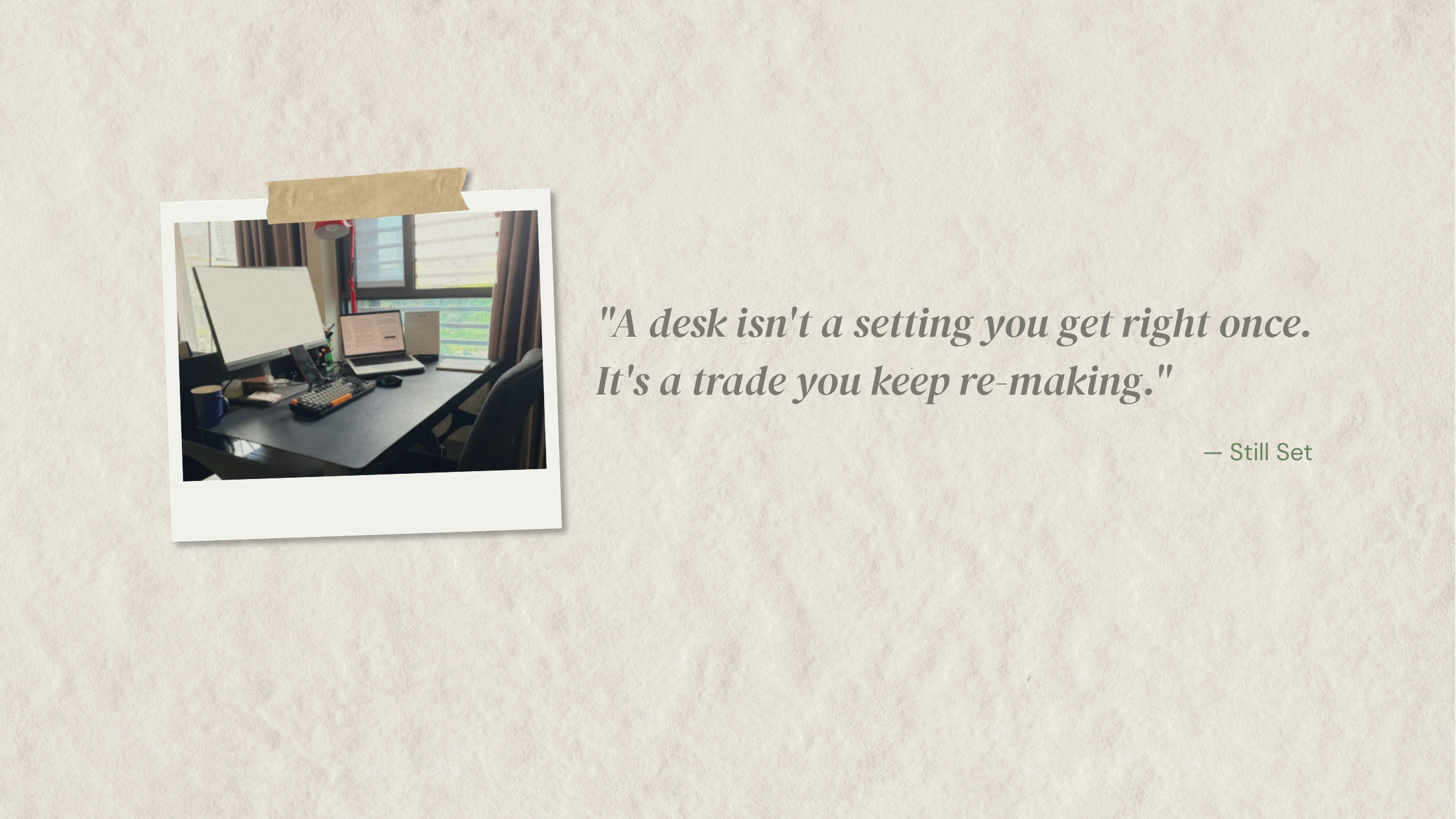
The real lesson wasn’t about windows. It was that a desk position is not a setting you get right once. It’s a series of trades you make on purpose, based on which problem you’d rather have.
If light in your eyes bothers you more than a boring view, face away from the window. If a blank wall makes you feel trapped, don’t face one, no matter how good it is for focus. If your room is small, that constraint outranks every layout tip written for a room that isn’t yours. The magazine version of a home office assumes a big room, a great view, and someone who behaves the way the article needs them to. You don’t have to be that person. You have to notice which trade you’re actually making. The same trap shows up in decluttering advice, which is also written as though one method fits every pile — it isn’t wrong, it’s just answering a different question than the one your desk is asking.
And here’s the honest limit, because I said I’d give you the honest limit: none of this fixed the thing I most wanted it to fix. I still sit too long. Facing an open room instead of a window made me slightly more willing to get up, but only slightly — the truth is that where I put the desk barely touches whether I remember to stand, stretch, and walk around. That still runs on nothing but my own willpower, and my willpower on a Tuesday afternoon is not a reliable piece of equipment. A good desk position can remove friction. It can’t supply discipline. I’d be selling you something if I pretended the furniture did the second job.
So if you’re staring at your room right now wondering which way to point the desk, here’s the whole thing in one line: try the window, but don’t marry it. It’s a starting position, not a destination. Move it when it’s wrong. You’re allowed to.
This is one of a few pieces I’m writing about the space I actually work in — you can find the rest here as I add them.
Eight months and three moves later, this is everything that is actually on that desk. If you’ve moved your desk around chasing this same feeling — I’d like to hear where yours ended up, and what it fixed or didn’t. Window, wall, or some third position you found by accident. Tell me in the comments; I read them, and the good ones quietly shape what I write next.
— Still Set
Try it on your own desk
What’s actually earning space on your desk?
Where the desk sits is one question. What’s allowed on the surface is the other one. Two minutes, and you’ll have three lists — keep, go, and the one you couldn’t call either way.
No account, nothing saved, nothing to install.