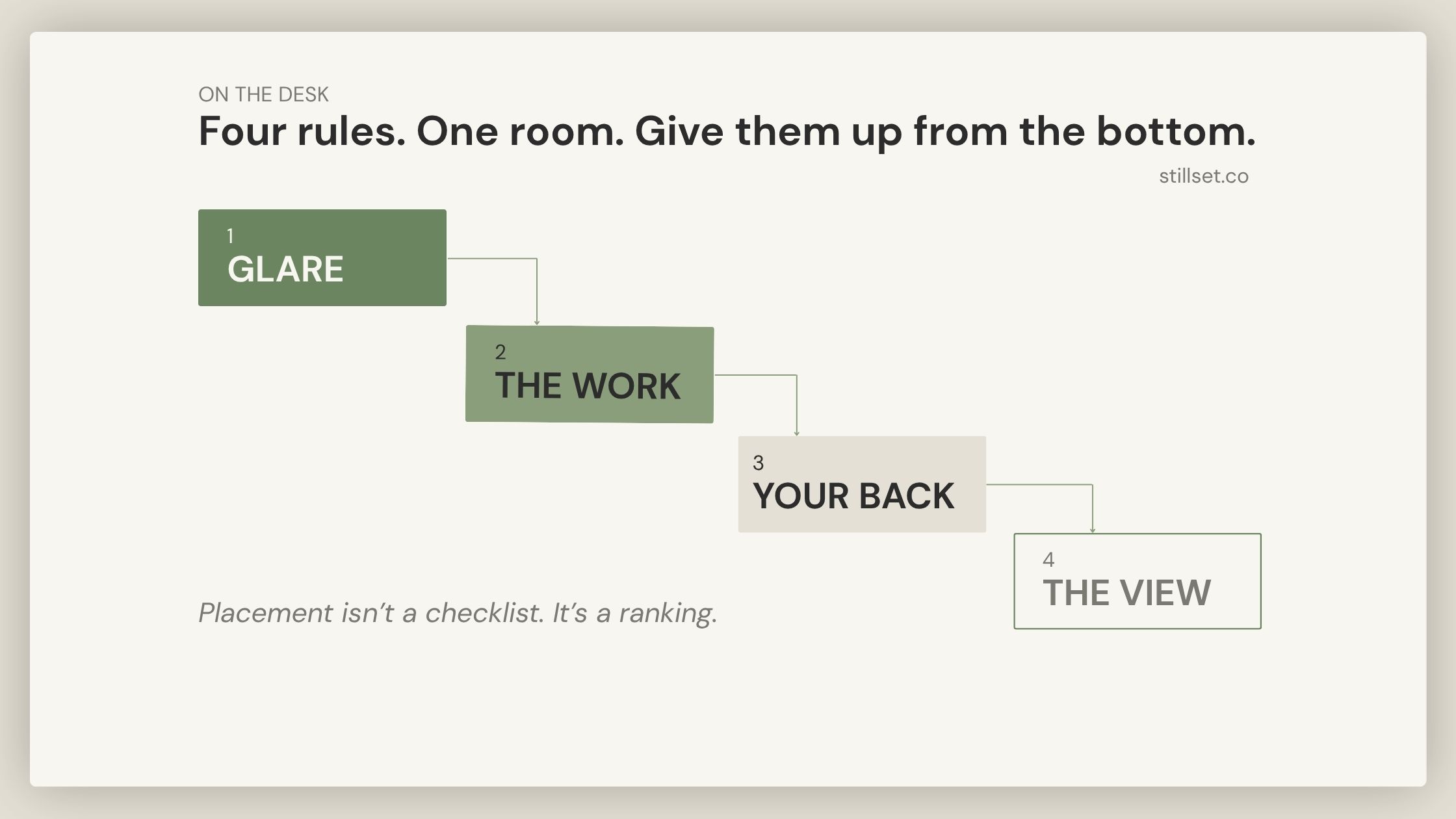
Home Office Desk Placement: Which Rule to Break When You Can’t Follow Them All
I have read, at a conservative estimate, forty articles about home office desk placement. They are remarkably consistent. Put the window to your side, not in front of or behind you. Don’t face a blank wall. Sit where you can see the door. Keep the desk near an outlet. Leave clearance behind your chair.
Every one of those is true. Not one of them is useful.
They’re not useful because they’re a list, and a list only helps if you can satisfy all of it — the same reason a list falls apart the moment you point it at the things actually on the desk. In the room I actually had — a corner of a small spare bedroom with one window, one door, and one wall long enough for a desk — the window rule and the door rule pointed at opposite corners. Following one meant breaking the other. Forty articles, and not a single one told me which one to give up.
That’s the thing nobody writes down: desk placement isn’t a checklist, it’s a ranking. You are not choosing a position. You are choosing what to sacrifice. And the reason it feels so hard is that you’re being handed five equally-weighted rules for a room that can only hold two of them.
So here’s the ranking, in the order I wish someone had given me before I moved my desk three times.
Why does every home office desk placement guide fail in a real room?
Because the guides are written for a room that doesn’t exist: a dedicated office, more than one usable wall, a window somewhere convenient, and no other function competing for the space.
Most of us are working in a room that was already something else. A bedroom corner. The end of a dining table. A hallway nook. In those rooms the constraints aren’t suggestions — they’re walls. And when the advice assumes you have options you don’t have, it reads as a description of somebody else’s house.
The other reason is subtler. The rules are usually presented in the order that photographs best. The view comes first, because the view is what makes the picture. Glare comes last, or not at all, because glare doesn’t show up in a photo. That’s exactly backwards from how the day actually goes.
Step 1: Where is the light coming from at 3pm?
Start here, always. Glare is the only item on the list that can make a desk unusable rather than just imperfect.
Everything else on this page is a preference you can adapt to. Light hitting your screen is not. If the brightest object in your field of view is the window rather than the monitor, you spend the day squinting at a washed-out screen, and by mid-afternoon your eyes ache in a way you’ll blame on the work.
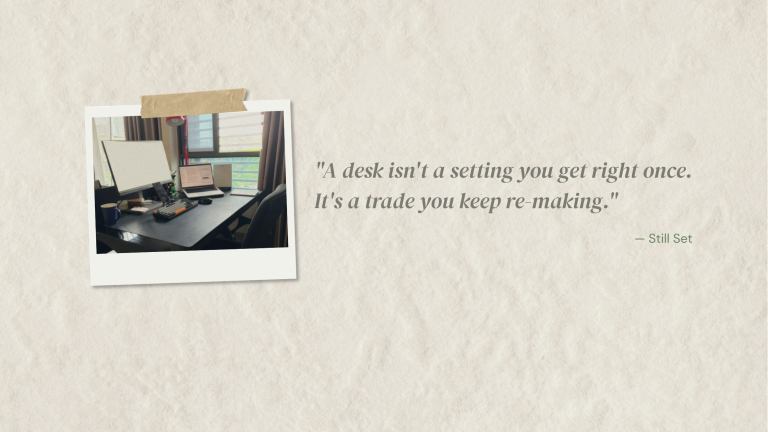
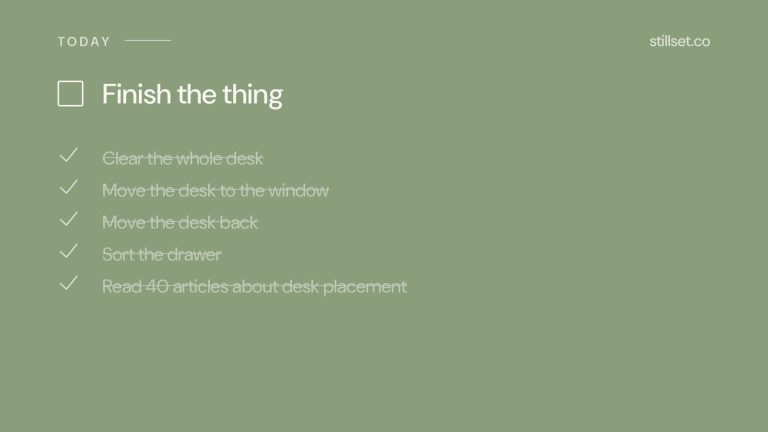
I know this because I did the thing all the articles recommend. I turned my desk to face the window, and for about a week it was lovely. Then the actual days started happening, and I discovered that a bright rectangle sitting just past your monitor is not a view, it’s a competitor. I’ve written the long version of that experiment elsewhere — I moved my desk to face the window and then moved it twice more before I stopped.
The research here cuts both ways, which is worth being honest about. Daylight and a view genuinely do improve how people work — a controlled study published in Building and Environment found cognitive performance, satisfaction and eyestrain all improved when office workers had daylight and a view compared to blackout shades, provided the glare was managed. Note the last clause. That’s the whole argument. Daylight is good. Uncontrolled daylight on a screen is not.
The rule: the window goes to your side. If your room only allows the window in front of you or behind you, in front is the lesser evil — behind you turns the screen into a mirror.
What you give up at this step: the photogenic setup. Nothing about a side-lit desk looks good in a photo. This is the trade I’d make every time.
Step 2: What do you actually do at this desk most days?
Second, because it decides whether the important side of you is the front or the back.
This is the question the guides skip entirely, and it’s the one that changes the answer most.
If most of your day is calls — video meetings, screen shares, being seen — then what’s behind you is a working surface. It needs to be a wall, a shelf, something unremarkable, and it needs light on your face rather than behind your head. Your placement is being decided by a camera, and you may as well admit it.
If most of your day is the other kind of work — writing, reading, thinking with a document open for two hours — then what’s behind you barely matters and what’s in front of you matters enormously. A blank wall in front of you is not the failure the design blogs make it out to be. When I turned my desk to face the wall, my focus measurably improved. Narrower field of view, less to look at, more work done.
If it’s genuinely both, decide by which one you’d hate to do badly. For most people that’s the calls, because the calls have witnesses.
What you give up at this step: the idea that one position serves both kinds of work equally. It doesn’t. Pick the one that describes more of your week and accept the other will be slightly worse.
The Desk Test
Placement is one decision. What sits on the surface is the other one.
It asks you the same question about each thing on your desk, and hands back three lists — including one for the things you couldn’t call either way.
Step 3: Is there traffic behind you?
Third, because this is the constraint that costs you attention all day without ever announcing itself.
By traffic I mean: does another person pass through this space while you’re working? A partner going to the kitchen. A kid coming in. A doorway you can’t see from your chair.
If the answer is yes, having your back to that doorway costs something real. Not fear — nothing that dramatic. It’s a low, background half-listening, the part of your attention permanently assigned to is someone behind me right now. You don’t notice it while it’s happening. You notice it when it stops.
This is where the feng shui “command position” advice comes from, and it’s worth saying that the underlying observation is sound even if you have no interest in the framework. Put a wall behind you, and the half-listening switches off.
I have to flag that this one is personal, not universal. For me, a wall behind my back settled something wordless. Some people find a wall behind them makes them feel cornered, and if that’s you, the whole step inverts. Trust your own version of that feeling over mine — but do actually check, because most people have never tested it.
What you give up at this step: possibly the best light. In a one-window room, the wall that protects your back and the wall that gives you side light are often not the same wall. If you have to choose: keep the light, and put something solid behind your chair instead — a bookshelf, a screen, the back of a sofa. A partial wall does most of the job.
Step 4: And the view?
Last. Genuinely last.
I’m not saying the view doesn’t matter. It matters, and it’s the most pleasant thing on this list. I’m saying it’s the item you should be most willing to trade, for two reasons.
First, it’s the one you can get without spending it on your desk position. You can turn your head. A window beside you at ninety degrees is still a window — you get the ten-second eye rest, you get the light, you get to watch the weather. You just don’t get to stare at it while pretending to work.
Second — and this is the part I didn’t expect — a view directly in front of you doesn’t stay restful. A window isn’t a painting. It’s a live feed. Someone walks past, a bird lands, a van reverses. Mine stopped being somewhere to rest my eyes and became somewhere to escape to. There’s a difference between a place to look away to and a place to look away from your work, and the second one is expensive.
What you give up at this step: the version of your desk you imagined. Which, for most of us, was mostly about the view.
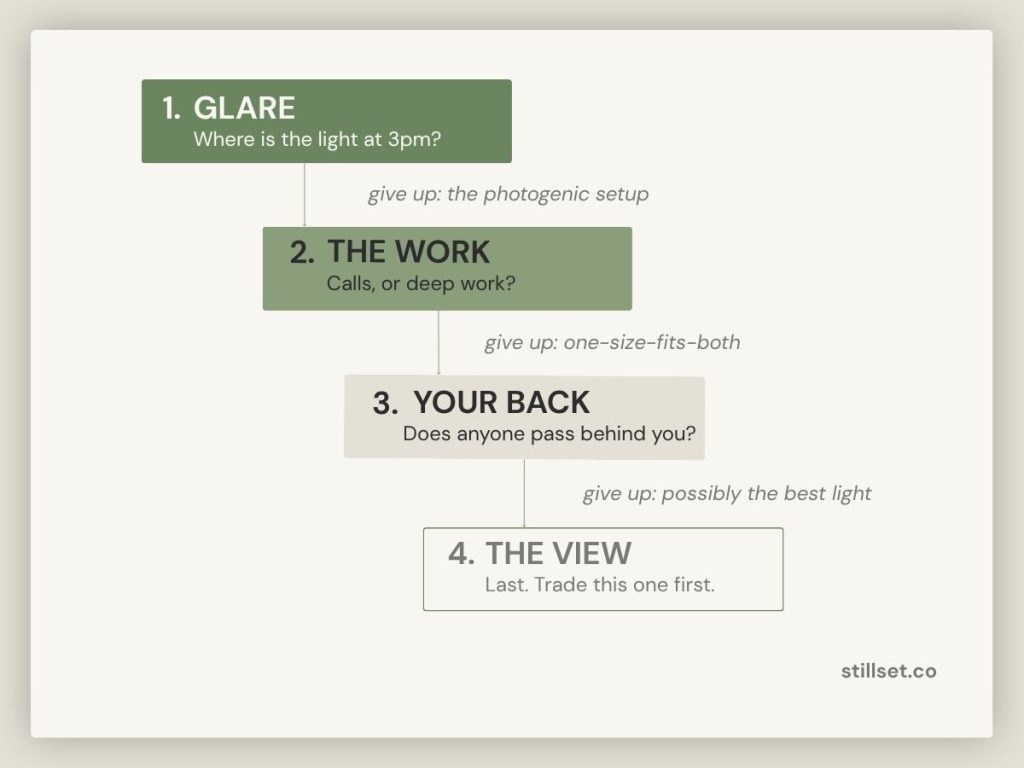
So what’s the actual order?
Here it is in one sentence, which is the only part worth writing on a card:
Glare first, then the work, then your back, then the view.
Not because those are the four most important things about a room. Because that’s the order in which giving one up hurts least. If your room forces a compromise — and it will — start giving them up from the bottom.
What this doesn’t fix
This is a ranking, not a solution, and there are rooms it can’t help.
It doesn’t help if the room has exactly one possible desk position. Some do. In that case the honest advice isn’t placement at all — it’s a lamp, a blind, and lowered expectations, in that order.
It doesn’t cover ergonomics. Chair height, monitor distance, desk height: those are real and they’re a different problem with different answers. Nothing here is a substitute for them.
It doesn’t account for the thing that made me move my desk the second time, which wasn’t on any list: a small room with a desk shoved against the wall closes in on you. Focus improved, and I wanted to leave the room the entire time. I don’t have a clean rule for that. It’s a fifth constraint that only appears in small rooms, and if you’re in one, weigh it somewhere near Step 2.
And I should say the obvious limitation of a ranking written by one person: I’ve tested this in exactly one house, across three positions, with one kind of work. The order held for me. Nobody has run a study on which desk constraint is cheapest to sacrifice, and if anyone tells you they know, ask them where the number came from.
Where I actually ended up
Back to a wall, window beside me, facing the open part of the room. Which is, funnily enough, what you get if you run these four steps in order on my room. It took three moves and about eight months to arrive at something I could have reached in an afternoon by asking better questions first.
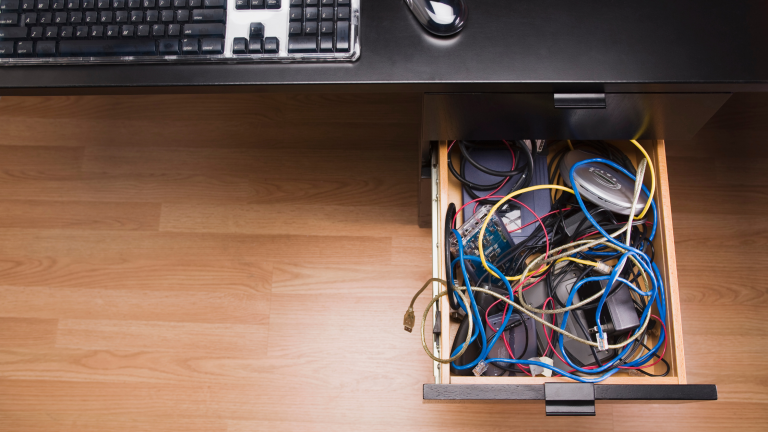
That’s the part I keep running into, in this room and elsewhere: the failure was never the answer I picked. It was that I was working through the questions in the order that made the prettiest picture, rather than the order that made the day survivable — which is more or less the same trap as thinking a cluttered desk is a tidying problem when it’s a deciding one.
Placement only settles where the desk goes; after that every object on a desk needs one home, which is a separate fight. If you want the shorter version of all this: notice what your desk position is asking you to spend, and check that you’d have agreed to the price.
— Still Set
Now for what’s on it
You’ve decided where the desk goes. Now decide what earns space on it.
Three lists, two minutes, and a box for the things you can’t decide about. We email you once on day fourteen to tell you what the box proved.
No account, nothing saved, nothing to install.