The Book to Get Out of a Reading Slump Is Smaller Than You Think
The two books that pushed me into my reading slump are still on my shelf. Deep Work and Atomic Habits — both abandoned somewhere around the first-quarter mark, both with bookmarks I’m too honest to remove.
So when I finally went looking for a book to get out of a reading slump, I almost made the same mistake in a new outfit. I did what you’re probably doing right now: I searched the lists. And every list promised the same cure — something gripping. Unputdownable. Guaranteed to hook you by chapter one.
I want to tell you why I stopped trusting that word, what I look for instead, and the five books that made the cut — including the honest part about which of them I’ve actually read.
Why didn’t a “gripping” book fix my reading slump?
Because gripping books still bill the same account. A thriller that demands two hours of my evening is asking for two hours I don’t have — the fact that I’d enjoy those hours doesn’t make them appear.
Here’s what my two DNFs taught me, once I stopped blaming myself for them. Deep Work and Atomic Habits aren’t bad books. They’re demanding books. Long arguments that build chapter on chapter, so that skipping ten days — which, with a job and two kids, I will — means re-reading to find the thread. They quietly assign homework: be better, apply this, become someone. By 9:30 p.m., when a brain that has already run a workday and a bedtime routine finally opens a book, an assignment is the last thing it can carry.
I wasn’t slumping because books stopped being interesting. I was slumping because I kept choosing books that needed more of me than I had left. And apparently I have company: a 2025 study in iScience by University College London and the University of Florida found that the share of Americans who read for pleasure on a given day fell from 28% in 2004 to 16% in 2023. Books didn’t get worse in those twenty years. Days got fuller.
Which means the fix isn’t a more exciting book. It’s a smaller ask.
What should you look for in a book to get out of a reading slump?
Look for a book that asks almost nothing of your attention: one you can stop anywhere, pick up free of charge, and finish a real piece of in about five minutes. That’s the whole secret, and it comes down to three criteria — the rule I now use for everything I recommend here at Still Set:
1. You can stop anywhere and lose nothing. Essays, vignettes, standalone chapters. If the book holds its meaning in small self-contained pieces, then a ten-day gap costs you nothing. No thread to find, no “wait, who is this character.” My DNFs failed here first: every pause had a re-entry fee.
2. One sitting costs five minutes, not an evening. The unit of reading has to fit inside the attention you actually have at the end of a real day — not the attention you wish you had. Five minutes is small enough that there’s no reason to say “not tonight.” And a finished essay is a finished thing; you close the book having completed something, which a chapter fragment never gives you.
3. It assigns no homework. No self-improvement mandate, no plot machinery to keep loaded in your head between sessions. The book should be over when you close it. This is the criterion that quietly disqualifies most of what I used to buy — books about becoming a better person are precisely the books that make reading feel like a second job.
Or, the way I’ve started saying it to myself: stop looking for a book exciting enough to fix your attention, and start looking for one small enough not to scare it.
What are the best books to get you out of a reading slump? Five that pass the test
Here they are — and first, the disclosure I wish more lists gave me: I’m reading exactly one of these right now. The other four are on my own waiting list, chosen by the same three criteria, based on what each book actually is rather than what I can pretend about it. The tested part of this article is the criteria. The list is where I’m pointing them next. I’d rather tell you that plainly than write “this book changed my life” about a book I haven’t opened.
1. The Book of Delights — Ross Gay · Status: reading now. For a year, Gay wrote one short essay a day about one small delight — a hundred-and-two of them, most under three pages. Each entry asks about five minutes of me, which is honestly all I have at 9:30 p.m. This is the book I chose to test my own criteria on, and six days in, I haven’t missed a morning yet. Here’s the strange part: reading one entry with my coffee feels less like Reading A Book and more like standing at the office coffee machine while a colleague tells you one small story from his yesterday. And because an entry is too short to overrun anything, it’s the first reading I’ve done in months without half an eye on the clock — I’m not managing time, so for five minutes the time isn’t managing me. It passes all three criteria without trying.
2. The Anthropocene Reviewed — John Green · On my list. Essays reviewing ordinary pieces of the human world — the QWERTY keyboard, sunsets, Canada geese — each one standalone, each one personal. If your day job involves a laptop and too many browser tabs, this is probably the voice on this list that will feel most like yours. Passes all three.
3. Before the Coffee Gets Cold — Toshikazu Kawaguchi · On my list. A Tokyo café where you can briefly return to the past, told in chapters that work almost as linked short stories. You can put it down mid-book and come back without a re-entry fee — which is exactly why it keeps showing up on readers’ own slump shelves on Goodreads.
4. Days at the Morisaki Bookshop — Satoshi Yagisawa · On my list. A slim, slow novel about a woman who moves into her uncle’s secondhand bookshop. Quiet chapters, small stakes, and — fittingly — a book about falling back in love with books. The whole thing is shorter than one section of the books I used to abandon.
5. The Housekeeper and the Professor — Yoko Ogawa · On my list, and the honest exception. This one is a continuous novel, so it technically fails my first criterion — there is a thread. It stays on the list because it passes everywhere else so gently: around 180 pages, calm sentences, a story about a mathematician whose memory resets every eighty minutes, which means the book itself keeps re-introducing you. If any continuous story is safe for a tired brain, it’s one built around starting over.
A note on the book I’m actually three weeks into: Four Thousand Weeks by Oliver Burkeman. It fits this article’s spirit perfectly — it’s a book about accepting limits — and it fails the criteria completely: one long argument, real re-entry fees. It survives in my life only because I gave it my best attention slot, a few minutes with morning coffee, before the day gets its hands on me. Which proves the point better than any recommendation could: these criteria aren’t about taste. They’re about matching the book to the attention you actually have. A demanding book needs your best hours. A slump means your best hours are spoken for.
What this list won’t do
I’d rather set this expectation than have you find out the hard way.
If you have attention to spare and just want to be swept away, this is the wrong list. The internet is full of genuinely good page-turner roundups, and for a reader whose tank isn’t empty, they’re right. These five are for the reader who can’t currently survive a page-turner’s demands.
A book choice won’t fix a slump that isn’t about books. Mine tracked almost perfectly with a stretch where work got heavier and sleep got worse. If that’s you, the more useful thing I’ve written is about being inside a reading slump and refusing to treat it as a malfunction — the book comes second to that.
None of these will hook you by chapter one. They’re quiet books. That’s not a flaw in the list; it’s the entire mechanism. A book that grabs you demands that you stay grabbed. A book that simply sits there, costing five minutes, is the one that’s still in your hand three weeks later.
Where I actually am
Six days into The Book of Delights, with my coffee, before anyone else in the house is asking me for anything. It’s the first book in months I haven’t dreaded picking up — not because it’s thrilling, but because it never asks for more than I have.
I keep a running list of what I’m reading (and stalling on, honestly labeled) on my Bookshop shelf — I update the status of each book there as it changes, including this one. If Delights stops holding, I’ll say so. The ones that already earned their place are the books that changed how I think, kept separately.
What was the book that actually restarted reading for you — and was it gripping, or was it just small? Tell me in the comments. I’m collecting evidence for the small ones.
I write about reading, work, and the spaces we do both in — mostly by noticing what actually happens instead of what’s supposed to.
— Still Set
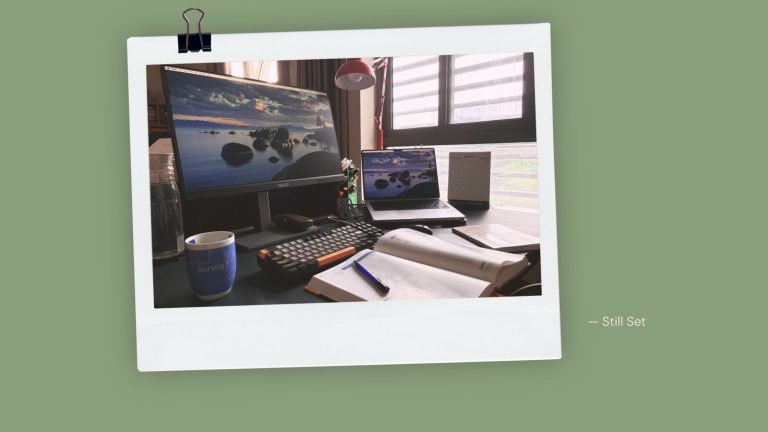
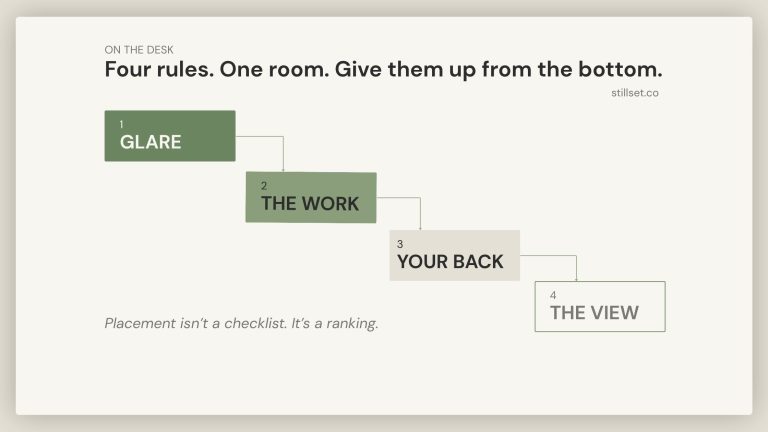
Same question, moved to the desk
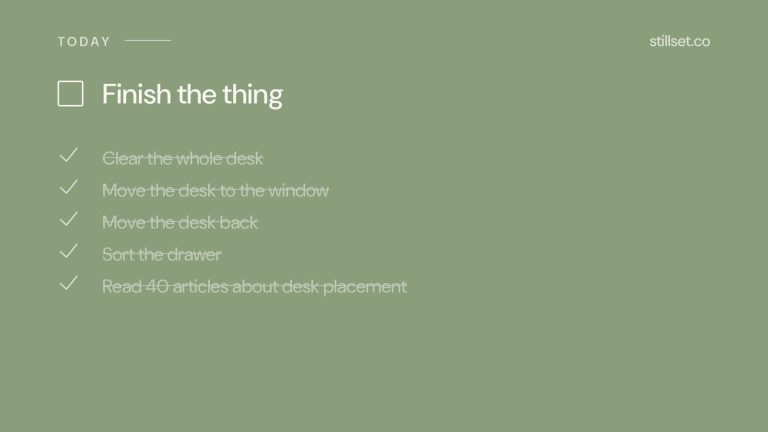
You worked out which book earns your evening. Nothing on your desk has been asked to earn anything.
Three lists, two minutes, and a box for the things you can’t decide about. We email you once on day fourteen to tell you what the box proved.
No account, nothing saved, nothing to install.
Disclosure: the book links above go to Bookshop.org, which supports independent bookstores. If you buy through them, Still Set earns a small commission at no extra cost to you. I only link books that pass the same criteria I hold my own shelf to — and I’ve told you plainly, above, which ones I’ve read.